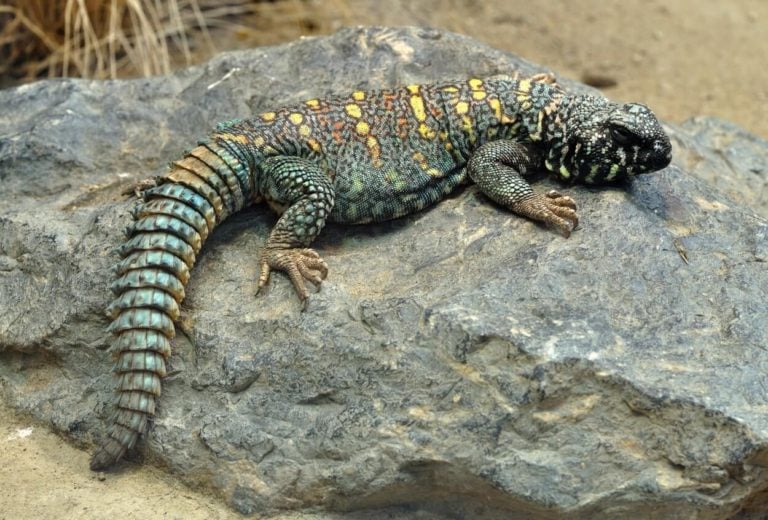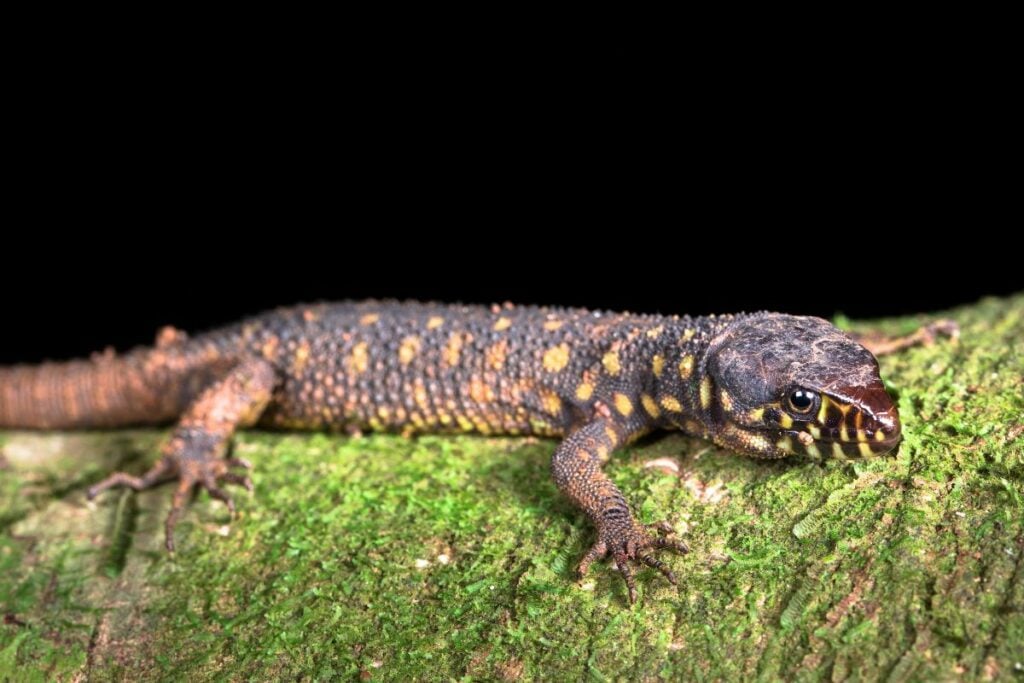
The yellow spotted tropical night lizard (Lepidophyma flavimaculatum) is one of Central America’s most intriguing but least-known reptiles. Secretive, nocturnal, and remarkably well-camouflaged, they spend their lives tucked inside rotting logs, rock crevices, and leaf litter. That is precisely why most people who live alongside them have never seen one. I find this species genuinely fascinating to read about precisely because it sits so far outside what most keepers ever encounter.
What makes them genuinely fascinating isn’t just their appearance (though their bold yellow-spotted pattern is striking). It’s their biology. Some populations reproduce entirely without males, making the yellow spotted tropical night lizard one of the few vertebrate species capable of true parthenogenesis. They also give birth to live young, which is unusual among lizards.
This guide covers everything you need to know: taxonomy, physical description, native habitat, diet, behaviour, reproduction, conservation status, and what’s involved if you’re considering keeping one.
Table of Contents
- Quick Facts
- Taxonomy and Classification
- Physical Appearance
- Native Range and Habitat
- Behaviour and Activity Patterns
- Diet: What Do Yellow Spotted Night Lizards Eat?
- Reproduction: Live Birth and Parthenogenesis
- Conservation Status
- Are Yellow Spotted Night Lizards Good Pets?
- Frequently Asked Questions
- What is the yellow spotted tropical night lizard?
- Where do yellow spotted tropical night lizards live?
- What do yellow spotted tropical night lizards eat?
- Do yellow spotted tropical night lizards lay eggs?
- Can yellow spotted tropical night lizards reproduce without males?
- Do yellow spotted tropical night lizards make good pets?
- References
Quick Facts
| Attribute | Detail |
|---|---|
| Scientific name | Lepidophyma flavimaculatum |
| Family | Xantusiidae (night lizards) |
| Common names | Yellow spotted tropical night lizard, Middle American night lizard |
| Adult size | 2.5–5 inches SVL; up to 8–9 inches total length with tail |
| Native range | Southern Mexico through Central America to Panama |
| Habitat | Tropical and subtropical moist broadleaf forest; rocky areas, rotting logs |
| Activity pattern | Nocturnal |
| Diet | Insectivore: ants, termites, beetles, spiders, centipedes |
| Reproduction | Viviparous (live birth); some populations reproduce by parthenogenesis |
| Lifespan | Unknown in wild; up to 10+ years possible in captivity |
| Conservation status | Least Concern (IUCN); CITES Appendix III (Honduras) |
| Kept as pets? | Rarely; specialist species with specific requirements |
Taxonomy and Classification
Lepidophyma flavimaculatum belongs to the family Xantusiidae (the night lizards), a small family of about 30 species found exclusively in the Americas, from the southwestern United States through Central America into South America. The Xantusiidae are an ancient lineage with a fossil record extending back over 60 million years, making them one of the older lizard families still represented today.[1]
Despite the name “night lizard,” members of Xantusiidae are not closely related to geckos, though they share many superficial similarities including secretive habits and nocturnal activity. The key distinction is that night lizards have moveable eyelids (unlike most geckos which have fixed, transparent eye coverings), and their scales have a distinctly different structure and arrangement. For more on how lizards and geckos differ, see our guide on the difference between lizards and geckos.
Physical Appearance

The yellow spotted tropical night lizard is immediately recognisable from its bold patterning: a dark base colour ranging from deep black to rusty brown, overlaid with rows of bright yellow or cream spots that run from the snout down the flanks to the base of the tail. These spots can be crisp and vivid in younger individuals but may fade or develop indistinct borders as the animal ages.
Key physical features include:
- Body colour: Dark black to rusty-brown dorsum with distinctive yellow lateral spotting; yellowish underbelly, sometimes with brownish patches
- Head: Shiny black with a few faded yellow spots; underside of the head a uniform brownish-grey. The lower jaw has a robust appearance with a banded dark-and-light pattern
- Upper lip: Typically black, often with small yellow spots along the labial scales
- Tail: Distinctly banded in alternating yellow, black, and brown, arguably the most visually striking part of the animal
- Scales: One of the most distinctive features of Lepidophyma is the strong contrast between dorsal and ventral scales. The dorsal (back) scales are significantly enlarged and keeled, giving the animal an almost spiky, robust texture. The ventral (belly) scales are smaller, smoother, and roughly square in shape
- Eyes: Large and moveable. Unlike gecko-like species, night lizards have functional eyelids they can close fully. The eyes are adapted for low-light sensitivity
- Size: Adults typically reach 2.5–5 inches snout-to-vent length (SVL), with the tail adding considerable additional length. Total length can reach 8–9 inches in large individuals, making them among the larger species within the Xantusiidae family
- Body shape: Flattened dorsoventrally (top-to-bottom): an adaptation that allows them to squeeze into tight rock crevices, beneath bark, and within rotting logs
Sexing these lizards by external features alone is difficult. Males and females look nearly identical to the untrained eye. In populations where males exist, they can be distinguished by the presence of enlarged femoral pores, but this requires close examination.
Native Range and Habitat
Lepidophyma flavimaculatum ranges from the Atlantic and Pacific lowland forests of southern Mexico southward through Guatemala, Belize, Honduras, El Salvador, Nicaragua, Costa Rica, and into Panama.[2] Within this range they occupy both Atlantic and Pacific coastal zones, including elevated areas exceeding 2,000 feet above sea level.
Their preferred habitat is tropical and subtropical moist broadleaf forest: the dense, humid rainforests of Central America where rainfall is high and the forest floor is rich in decaying organic matter. Within this habitat they are specifically associated with microhabitats that provide dark, humid hiding places:
- Rotting logs: the interior of decaying logs provides consistent humidity, stable temperature, and abundant invertebrate prey
- Rock crevices: the flattened body shape is a clear adaptation for exploiting these spaces
- Tree trunks and beneath loose bark: particularly in older, more decomposed trees
- Leaf litter: foraging at or near the surface at night
- Termite mounds: both a hiding spot and a food source, given termites are a primary prey item
Despite the reasonably large geographic range, yellow spotted tropical night lizards are genuinely difficult to find in the wild. Their cryptic colouration (the dark body with broken yellow spots) is highly effective camouflage against the dappled light of the forest floor and the mottled surface of rotting wood. Their strictly nocturnal habits mean daytime observers rarely encounter them. Even herpetologists conducting targeted surveys often find them only by systematically splitting rotting logs and checking rock undersides at night.
Behaviour and Activity Patterns
Yellow spotted tropical night lizards are, as their name suggests, primarily nocturnal, emerging after dark to forage within and around their microhabitats. During the day they remain hidden in their retreats, relying on the stable humidity and temperature of their chosen hiding spots rather than basking in sunlight as diurnal lizards do.
This is a significant difference from most commonly kept lizards like bearded dragons or green iguanas, which are diurnal baskers requiring strong UVB lighting and thermal gradients for thermoregulation. Night lizards are thermoconformers to a much greater degree, using the ambient warmth of their microhabitat rather than active basking. This has direct implications for captive care.
In terms of social behaviour, Lepidophyma flavimaculatum is largely solitary and does not appear to be territorial in the same way that many diurnal lizard species are. Multiple individuals may share suitable retreats, particularly in areas where good microhabitats are scarce, but social interaction is minimal outside of breeding contexts.
When threatened, they rely first on their cryptic colouration and flat profile to avoid detection. If discovered, they will attempt to escape into the nearest crevice. They are not particularly fast runners compared to more open-habitat lizard species. Their evolutionary strategy is concealment rather than speed.
Diet: What Do Yellow Spotted Night Lizards Eat?
These lizards are strict insectivores. Their diet in the wild consists entirely of invertebrates found within and around their microhabitats. Documented prey items include:
- Ants: likely the single most important prey item given the abundance of ant colonies within and around rotting logs
- Termites: a primary food source, particularly where termite colonies share the same decaying wood microhabitat
- Beetles and beetle larvae: both adult beetles and soft-bodied grubs found in decaying wood
- Spiders
- Centipedes
- Flies and other small flying insects
- Scorpions: occasional prey in areas of overlap
The concentration of hunting within their immediate microhabitat rather than ranging widely is a characteristic of the family. Night lizards are sit-and-wait foragers to some degree, but also actively patrol the interior surfaces of their retreats where invertebrate density is highest.
Captive Diet
In captivity, a varied insect diet is essential. Suitable feeder options include small crickets, small dubia roaches, fruit flies (Drosophila) for smaller individuals, small waxworms (as an occasional treat; see our waxworm care guide), small mealworm larvae, and termites where available from clean sources. Ants from clean captive colonies can also be offered.
All prey should be gut-loaded for 24–48 hours before feeding and dusted with a calcium supplement at every meal. A D3-containing multivitamin should be added once weekly. Given their low-light, non-basking lifestyle, UV-triggered D3 synthesis is limited, making oral supplementation with D3 particularly important for this species.
Reproduction: Live Birth and Parthenogenesis
The reproductive biology of Lepidophyma flavimaculatum is one of the most remarkable aspects of the species, and one of the most frequently cited examples of vertebrate parthenogenesis in the scientific literature.
Viviparous Reproduction
Unlike the majority of lizard species (which lay eggs), yellow spotted tropical night lizards are viviparous, meaning they give birth to fully formed live young. This is a relatively uncommon reproductive strategy among reptiles, found in some skink species, certain snake species, and a handful of other lizard families. In Lepidophyma, the embryos develop within the mother, nourished internally, and emerge as independent miniature versions of the adults.
Litter sizes are typically small, ranging from 1 to 9 offspring depending on the size and condition of the female. The young are born fully formed and immediately independent.
Parthenogenesis: Reproduction Without Males
Even more remarkable than live birth is the documented capacity for parthenogenesis in many populations of Lepidophyma flavimaculatum. Parthenogenesis is a form of asexual reproduction in which females produce offspring from unfertilised eggs. No male required.[3]
In the case of this species:
- All-female populations are common and well-documented, particularly in southern Central America. In these populations, no males have ever been recorded. Females reproduce entirely by parthenogenesis, producing genetically identical (or nearly identical) female offspring
- Mixed-sex populations do exist and reproduce sexually, particularly in northern portions of the range (southern Mexico and parts of Guatemala)
- The all-female populations appear to be entirely self-sustaining, a remarkable evolutionary strategy that allows rapid colonisation of suitable habitat without the need for finding a mate
To put that in perspective: entire lineages of this lizard have reproduced without a male for generations, producing viable, healthy offspring indefinitely. This makes Lepidophyma flavimaculatum one of a small number of vertebrate species where parthenogenesis is not just a rare occurrence but a stable, population-level reproductive strategy, alongside species like the Komodo dragon (in some circumstances), certain whiptail lizards (Aspidoscelis), and some shark species.
Conservation Status
Lepidophyma flavimaculatum is currently classified as Least Concern on the IUCN Red List, reflecting its relatively wide distribution and presumed stable populations across much of its Central American range.[2] However, the species is listed on CITES Appendix III (by Honduras), which means international trade in specimens from Honduras requires documentation and export permits.
The primary threats to the species are habitat-related. Deforestation and degradation of tropical forest in Central America removes both the humid microhabitats these lizards depend on and the invertebrate prey communities that sustain them. Their dependence on rotting log and rock crevice microhabitats makes them particularly sensitive to logging and agricultural conversion of forest habitat.
Are Yellow Spotted Night Lizards Good Pets?
The honest answer is that yellow spotted tropical night lizards are a specialist species not well-suited to most keepers, and certainly not recommended as a first reptile.
Challenges
- Rarely captive bred: most specimens available in the reptile trade are wild-caught, which raises conservation and welfare concerns and means animals typically arrive stressed, parasite-laden, and unaccustomed to captivity. Wild-caught animals also frequently refuse to feed initially
- Strictly nocturnal: you will rarely see them during the day. They spend most of their time hidden and are not interactive pets in the way that a leopard gecko or bearded dragon can be
- Secretive and stress-prone: unlike many commonly kept lizards, night lizards do not tame easily and do not tolerate frequent handling well. They are best considered display animals
- Specialist diet: their natural diet of ants and termites is difficult to replicate in captivity. Providing adequate dietary variety requires sourcing small, appropriately-sized live prey consistently
- Limited information: captive care protocols are not well-established compared to species like leopard geckos or crested geckos. You will be working with limited resources if problems arise
Basic Captive Care Requirements
For those experienced keepers who do choose to work with this species, here are the fundamental requirements:
- Enclosure: A secure, escape-proof vivarium with plenty of cork bark, flat rocks, and other tight retreats. A 24″ x 18″ x 18″ enclosure is a reasonable minimum for a pair or small group. Deep substrate (a mix of coco coir, peat, and leaf litter) allows burrowing and maintains the humidity they require
- Temperature: Ambient temperature of 72–78°F with no need for a high-intensity basking spot. A gentle heat mat on a thermostat providing a warm side of around 80°F is sufficient. Avoid high temperatures. These are forest animals, not desert dwellers
- Humidity: 70–80% ambient. Regular misting of the enclosure and damp substrate are essential. The enclosure should never fully dry out
- Lighting: Low-intensity UV lighting on a 12-hour day/night cycle supports circadian rhythms even in nocturnal species. A low-output UVB tube (similar to the Arcadia 6% ShadeDweller used for other crepuscular species) is recommended, though research on optimal UV levels for this species is limited
- Diet: Small crickets, fruit flies, small dubia roaches, small waxworms occasionally, small mealworm larvae. Dust with calcium at every meal; multivitamin with D3 once weekly
If you’re attracted to a secretive, nocturnal lizard as a display animal and have experience with specialist reptiles, the yellow spotted tropical night lizard can be a genuinely rewarding species to work with. If you’re looking for an interactive pet, a beginner-friendly alternative from our list of the best pet lizards will serve you much better.
Frequently Asked Questions
What is the yellow spotted tropical night lizard?
The yellow spotted tropical night lizard (Lepidophyma flavimaculatum) is a nocturnal lizard from the rainforests of Central America, ranging from southern Mexico to Panama. It belongs to the family Xantusiidae (night lizards) and is known for its striking dark body with rows of yellow spots, its viviparous (live birth) reproduction, and the remarkable capacity of some populations to reproduce entirely by parthenogenesis without males.
Where do yellow spotted tropical night lizards live?
They live in tropical and subtropical moist broadleaf forests across Central America, from southern Mexico through Guatemala, Belize, Honduras, El Salvador, Nicaragua, Costa Rica, and Panama. Within this range they occupy microhabitats including the interior of rotting logs, rock crevices, beneath loose bark on tree trunks, and under leaf litter. They prefer humid, dark retreats and are found from lowland coastal forest up to elevations exceeding 2,000 feet.
What do yellow spotted tropical night lizards eat?
They are strict insectivores. In the wild their diet consists primarily of ants, termites, beetles and beetle larvae, spiders, centipedes, and other small invertebrates found within their microhabitats. In captivity they can be fed small crickets, fruit flies, small dubia roaches, and small mealworm larvae, with all prey gut-loaded and dusted with calcium and vitamin supplements.
Do yellow spotted tropical night lizards lay eggs?
No. They are viviparous, meaning they give birth to live young rather than laying eggs. This is unusual among lizards. Litter sizes are typically 1–9 offspring. Many populations also reproduce by parthenogenesis, a form of asexual reproduction in which females produce offspring without fertilisation by a male, resulting in all-female populations.
Can yellow spotted tropical night lizards reproduce without males?
Yes. This is one of the species’ most remarkable biological features. Many populations, particularly in southern Central America, are entirely female and reproduce by parthenogenesis, producing viable offspring from unfertilised eggs. These all-female populations appear to be stable and self-sustaining over generations. Populations in northern areas of the range (Mexico, Guatemala) reproduce sexually and contain both males and females.
Do yellow spotted tropical night lizards make good pets?
They are a specialist species best suited to experienced keepers rather than beginners. They are strictly nocturnal and rarely visible during the day, do not tame well, require high humidity and a specific diet of small invertebrates, and are rarely captive-bred (most available animals are wild-caught). If you’re looking for a beginner-friendly nocturnal lizard, a leopard gecko or African fat-tailed gecko is a much more suitable choice.
The yellow spotted tropical night lizard is one of those species that rewards close attention. Once you look past its cryptic habits and appreciate its biology, it’s a genuinely extraordinary animal. Live birth in a lizard is uncommon enough; entire self-sustaining populations of females reproducing without any males is in a different category entirely.
Whether you’re a naturalist curious about Central American wildlife, a herpetologist, or an experienced keeper considering something outside the mainstream, Lepidophyma flavimaculatum is well worth knowing about. For those interested in more accessible nocturnal lizards as pets, our guide to the best pet lizards covers plenty of rewarding options for all experience levels.
References
- Uetz, P., et al. (eds.) The Reptile Database. Lepidophyma flavimaculatum. Available at: reptile-database.reptarium.cz
- IUCN SSC. Lepidophyma flavimaculatum. The IUCN Red List of Threatened Species. Available at: iucnredlist.org
- Bezy, R.L. & Camarillo, J.L. (2002). Systematics and Natural History of Night Lizards, Genus Lepidophyma, in Central America. Contributions in Science. Natural History Museum of Los Angeles County. doi:10.2307/1564562