If you’ve noticed your leopard gecko sleeping all day and only becoming active in the evenings, you might assume they’re nocturnal. The truth is slightly more nuanced — and understanding it properly will help you set up their enclosure correctly, time their meals well, and know what to expect from their daily behaviour.
Leopard geckos are technically crepuscular, not strictly nocturnal. Crepuscular means they are most active at twilight — around dusk and dawn — rather than through the middle of the night. In the wild, this behavioural pattern evolved as the optimal survival strategy for their native habitat in the rocky deserts of South Asia. In captivity, this instinct remains deeply ingrained regardless of their enclosure conditions.
Table of Contents
- Nocturnal vs Crepuscular: What’s the Difference?
- Why Are Leopard Geckos Crepuscular?
- What Do Leopard Geckos Do During the Day?
- What Do Leopard Geckos Do at Night?
- How Crepuscular Behaviour Should Shape Your Care Routine
- Is My Leopard Gecko Nocturnal or Crepuscular? Does It Matter?
- Frequently Asked Questions
- Final Thoughts
- References
Nocturnal vs Crepuscular: What’s the Difference?
These terms describe an animal’s peak activity period relative to the day/night cycle:
- Diurnal — active primarily during the day (e.g. bearded dragons, iguanas)
- Nocturnal — active primarily during the night (e.g. many snake species, tokay geckos)
- Crepuscular — active primarily at dawn and dusk, with reduced activity during both midday and the middle of the night
Leopard geckos fall into the crepuscular category, though in captivity their behaviour often leans more toward the nocturnal end of the spectrum — they’ll frequently remain active well into the evening hours, especially when temperatures are comfortable. This is still driven by the same underlying biology: avoiding the midday heat while remaining less exposed than purely nocturnal animals during the darkest hours.[1]
Why Are Leopard Geckos Crepuscular?
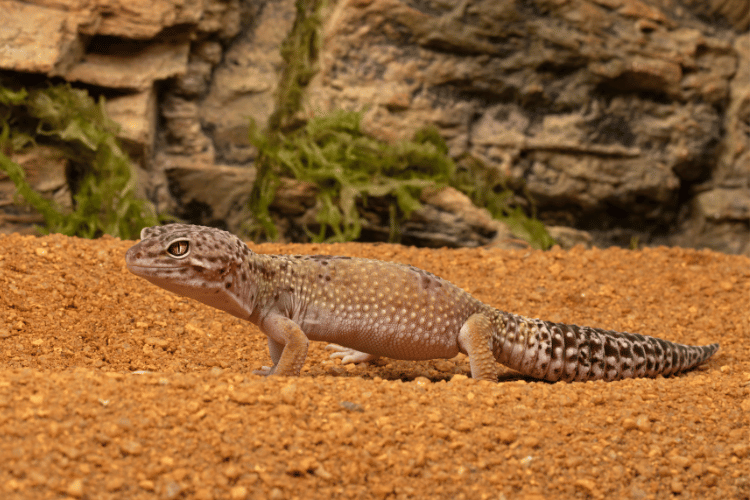
In the wild, leopard geckos (Eublepharis macularius) inhabit the rocky, semi-arid deserts and scrublands of Pakistan, Afghanistan, India, and Iran.[2] Daytime temperatures in these regions regularly exceed 100°F (38°C) at ground level — far too hot for a small gecko to safely remain exposed. Their crepuscular activity pattern evolved as a direct response to this environment for three key reasons:
1. Thermoregulation
As ectotherms, leopard geckos rely on their environment to regulate body temperature. The twilight hours provide warm — but not dangerously hot — substrate temperatures from the sun’s accumulated heat. This allows them to be active and hunt without the risk of overheating that daytime activity would bring. Understanding this helps explain why night-time temperature management is so important in captive setups — their most active hours coincide with the enclosure’s coolest period.
2. Predator Avoidance
The dusk and dawn hours offer a middle ground between the vulnerability of full daylight (when aerial predators are active) and the pitch-black middle of the night (when larger nocturnal predators dominate). The lower-light conditions also provide cover while still allowing the gecko’s excellent vision to function — leopard geckos have highly sensitive eyes capable of detecting colour in near-darkness, an adaptation that gives them a visual advantage over many predators at twilight.[3]
3. Prey Availability
Insects — the primary prey of leopard geckos — are most active at dusk and dawn in arid environments, when temperatures are tolerable and moisture from ground cooling makes them more accessible. A gecko that hunts during these hours faces less competition and encounters more prey than one hunting at any other time of day.
What Do Leopard Geckos Do During the Day?

During daylight hours, leopard geckos sleep — usually for 12–13 hours. In the wild they retreat into rock crevices and burrows where the temperature is cooler and stable. In captivity, they’ll use their hides for the same purpose.
You’ll typically find your leopard gecko in one of two places during the day:
- The warm hide — positioned on the warm side of the enclosure (over or near the heat mat). A gecko sleeping here is thermoregulating — using the warmth to aid digestion or general metabolic function
- The cool hide — on the cooler side of the enclosure. Geckos retreat here when they want to sleep at a lower ambient temperature, or during shedding when they seek higher humidity
A gecko sleeping in the open on the floor of its enclosure (rather than in a hide) is usually a sign of a comfortable, well-socialised animal that feels safe in its environment — not a cause for concern. However, if you notice your gecko sleeping in unusual positions, refusing to enter hides, or appearing lethargic during its active hours, check the enclosure temperatures first. Temperature problems are the most common cause of abnormal behaviour in leopard geckos — see our guide on leopard gecko heating for correct setup guidance.
It’s also worth noting that younger, juvenile leopard geckos may emerge briefly during the day more often than adults — typically because their faster metabolic rate and feeding schedule drives more frequent activity. Adults, particularly older ones, tend to conserve energy and stick more rigidly to the crepuscular pattern.
What Do Leopard Geckos Do at Night?

From dusk onward, a healthy leopard gecko becomes noticeably more active. In a well-set-up enclosure you’ll observe a range of behaviours during the evening hours:
Hunting and Feeding
This is peak feeding time. Leopard geckos in the wild are active predators — they stalk and pursue prey rather than ambushing it. In captivity, this hunting instinct is still very much present. Offering food at the start of the active period (around dusk) aligns with their natural rhythm and tends to produce the best feeding responses. This is why the leopard gecko feeding schedule recommends offering food in the evening. Tong-feeding or allowing them to hunt live feeders around this time takes advantage of their peak motivation.
Exploration and Territorial Behaviour
Leopard geckos are curious and will methodically explore their enclosure during active hours — investigating hides, climbing decor, and patrolling the perimeter. This is normal and healthy. An enclosure with enrichment items gives them more to investigate and helps keep them mentally stimulated. If your gecko consistently stays in one corner or refuses to explore, it may indicate stress — signs of a sick leopard gecko are worth reviewing if you’re concerned.
Drinking
Leopard geckos drink during their active period. A shallow water dish should always be available and refreshed daily. Dehydration is a common and preventable problem in captive geckos, partly because owners sometimes assume geckos don’t drink much. They do — particularly after feeding and during shedding.
Defecation
Most leopard geckos defecate during or after their active period. Many develop a preference for defecating in a specific corner of their enclosure — a useful behaviour that simplifies spot-cleaning. Understanding this rhythm is helpful when monitoring your gecko’s health, as changes in defecation frequency or appearance are often the earliest signs of digestive or dietary issues. Our leopard gecko poop guide covers what’s normal and what to watch for.
Shedding
Shedding often happens during the active period. Leopard geckos typically shed rapidly — the entire process can be complete in under an hour — and they almost always eat their shed skin immediately afterwards. It’s common for owners to never actually witness a shed because it happens so quickly at night.
How Crepuscular Behaviour Should Shape Your Care Routine
Feeding: Always Offer at Dusk
Time your gecko’s meals to coincide with the start of its active period — typically as the room light dims or around 30–60 minutes after the enclosure lights go off. This is when feeding drive is highest and rejection rates are lowest. Adult leopard geckos are fed every other day; juveniles under 12 months should be fed daily. Offering food in the morning when your gecko is deep asleep wastes feeders, stresses the gecko, and won’t produce a good feeding response.
Lighting: Day-Night Cycle Matters
Despite being crepuscular, leopard geckos still need a clear day-night light cycle to maintain healthy circadian rhythms. Provide 12–14 hours of light during the day (a low-wattage bulb or ambient room light is sufficient) and complete darkness at night. Avoid any bright light sources at night — this disrupts their activity cues and can cause chronic stress.
On the question of whether leopard geckos need UVB — the research increasingly suggests low-level UVB is beneficial even for crepuscular geckos. Current best practice is to provide a low-output UVB lamp (2.0 or 5.0 T5 HO) on a 12-hour day cycle, giving your gecko the option to use it during any daytime periods of activity without forcing exposure.
For night-time heating, avoid visible red or blue “night lights” — red lights are not invisible to leopard geckos as is commonly claimed, and constant light exposure disrupts their natural activity pattern. A ceramic heat emitter (CHE) or thermostat-controlled heat mat is the correct approach for maintaining appropriate night-time temperatures without any light output.
Handling: Work With Their Schedule
The best time to handle your leopard gecko is during their active period — early evening when they’ve naturally woken up and are alert. Most leopard geckos tolerate handling well once properly socialised, but approaching them during deep daytime sleep is more likely to cause a startled, defensive response.
If you need to interact with your gecko during the day — for spot-cleaning, health checks, or weight monitoring — do so calmly and gently. The occasional daytime disturbance won’t cause lasting issues as long as it’s not constant. What you should avoid is repeatedly disrupting sleep on a daily basis, as chronic sleep disruption affects immune function and overall wellbeing in reptiles just as it does in other animals.[4]
Observing Your Gecko
Because leopard geckos are most active when you might be winding down for the evening, it’s easy to miss behavioural changes that could signal a health problem. Getting into the habit of briefly observing your gecko during their active period — checking that they’re moving normally, hunting with interest, and not showing signs of lethargy or respiratory distress — takes only a few minutes and is the most reliable way to catch problems early. Our guide on the signs of a sick leopard gecko covers what to look for in detail.
Is My Leopard Gecko Nocturnal or Crepuscular? Does It Matter?
In practice, the distinction between crepuscular and nocturnal matters less than understanding the core principle: your leopard gecko sleeps during the day and is active in the evenings. Whether they peak at dusk, remain active until midnight, or vary by season and age, the care implications are the same — feed at dusk, maintain a day-night light cycle, heat without visible light at night, and observe during their active hours.
Captive leopard geckos will often adapt their activity timing somewhat to their environment and their owner’s schedule. A gecko that regularly sees its owner at 9pm may begin emerging earlier in anticipation. This flexibility within their crepuscular framework is a sign of a comfortable, well-adjusted animal — one of the many reasons leopard geckos make such excellent pets.
Frequently Asked Questions
Are leopard geckos nocturnal or crepuscular?
Leopard geckos are crepuscular — most active at dawn and dusk — rather than strictly nocturnal. In captivity their activity pattern often leans toward the nocturnal end, with most activity occurring in the evening hours. The distinction matters less than understanding the core principle: they sleep during the day and are active from dusk onward.
Why is my leopard gecko only active at night?
This is their natural, instinctive behaviour. In the wild, leopard geckos evolved as crepuscular animals in the hot, rocky deserts of South Asia. Being active during cooler twilight hours allowed them to thermoregulate safely, avoid daytime predators, and exploit peak insect activity. This rhythm is hardwired and persists in captivity regardless of enclosure conditions.
What time should I feed my leopard gecko?
Feed your leopard gecko at dusk — around the time their enclosure lights go off or as the room dims in the evening. This aligns with their natural peak feeding drive and produces the best response. Avoid offering food in the morning when they are in deep sleep. Adults are fed every other day; juveniles under 12 months should be fed daily.
Can I wake my leopard gecko during the day?
Occasional daytime interaction is fine and won’t cause lasting harm. The best approach is to wait until they’ve been asleep for a few hours (rather than disturbing them immediately after they’ve settled), interact gently, and keep the session brief. Avoid waking them every day during deep sleep, as chronic sleep disruption negatively affects immune function and overall wellbeing.
Do leopard geckos need light at night?
No — leopard geckos should have complete darkness at night. Avoid red, blue, or any other coloured ‘night bulbs’ — leopard geckos can detect these wavelengths and constant light exposure disrupts their activity cues. Use a ceramic heat emitter or thermostat-controlled heat mat for night-time heating without any light output.
Is it normal for leopard geckos to be active during the day sometimes?
Occasional brief daytime activity is normal, particularly in juveniles, during shedding periods, or in geckos that are comfortable and well-settled in their environment. Consistent daytime activity or a sudden shift away from the normal sleep pattern can indicate temperature problems, stress, illness, or reproductive activity (gravid females often become more restless). Check enclosure temperatures first if you notice unusual daytime activity.
Final Thoughts
Leopard geckos are crepuscular animals whose activity patterns are shaped by millions of years of evolution in the hot deserts of South Asia. In captivity, this means they sleep through most of the day and come alive in the evenings — and your care routine should be built around this rhythm rather than against it.
Feed at dusk, maintain a proper day-night light cycle, use heat without visible light at night, and observe your gecko during their active hours. Do those things consistently and you’ll have a well-adjusted, healthy gecko that thrives on its natural schedule.
For a complete overview of everything involved in keeping a leopard gecko well, visit our leopard gecko care guide — covering enclosure setup, temperatures, diet, handling, health, and more.
References
- Regal, P.J. (1983). The adaptive zone and behavior of lizards. In: Lizard Ecology. Harvard University Press. doi:10.1163/156853902760390413
- IUCN Red List. Eublepharis macularius (Leopard Gecko). Available at: iucnredlist.org
- Röll, B. (2001). Gecko vision — visual cells, evolution, and ecological constraints. Journal of Neurocytology. doi:10.1098/rsbl.2009.0387
- Rattenborg, N.C., et al. (2012). Unilateral eye closure and interhemispheric EEG asymmetry during sleep in the pigeon. Philosophical Transactions of the Royal Society B. doi:10.1098/rstb.2012.0010