This is one of the most common questions I get from new leopard gecko owners — and it’s a great one to ask before you start handling, not after.
I’ve kept leopard geckos for over a decade, and my gecko Geek has been part of the family for years. In that time I’ve learned that the answer to “do they like being held?” is more nuanced than a simple yes or no.
The short version: leopard geckos don’t seek out human contact the way a dog or cat does. They’re reptiles — they don’t form emotional attachments in the mammalian sense. But with patience, consistency, and the right approach, most leopard geckos will become genuinely comfortable with handling, and some seem to actively enjoy the warmth and stimulation of time outside their enclosure.
Here’s everything you need to know to get it right.

Table of Contents
- Do Leopard Geckos Actually Enjoy Being Held?
- How To Tell If Your Leopard Gecko Is Comfortable Being Held
- How To Build Trust: A Step-By-Step Taming Guide
- When You Should NOT Handle Your Leopard Gecko
- Does Age Affect How Quickly They Tame?
- How Often Should You Handle A Leopard Gecko?
- Wrapping Up
- Frequently Asked Questions
Do Leopard Geckos Actually Enjoy Being Held?

As a general rule, leopard geckos show indifference rather than enthusiasm when it comes to being held — at least initially. They don’t hate it, but they don’t crave it either. Whether they come to enjoy it depends almost entirely on how much trust has been built between you and your gecko over time.
This is backed up by what we know about reptile cognition. According to research published in the journal Animal Cognition, reptiles are capable of associative learning and can form positive associations with specific people and situations over time — they just don’t process social interaction the way mammals do. What looks like “enjoyment” in a well-handled gecko is more accurately described as habituation combined with a positive learned association.
In practical terms: a leopard gecko that has been handled correctly from a young age, introduced to its owner gradually, and never stressed during handling will eventually settle calmly in your hands. My gecko Geek will sit on my forearm for 15-20 minutes without any attempt to escape — that’s not indifference, that’s a gecko that has learned that being out with me is safe and sometimes involves a mealworm treat.
That said, every gecko is different. Some will warm up quickly — within a few weeks of consistent handling. Others take months. A small number of leopard geckos, particularly those that were poorly socialised as juveniles or are naturally more skittish, may never become fully relaxed with handling. Respecting that individual variation is part of being a good owner.
The British Herpetological Society recommends that keepers always allow new reptiles a minimum settling-in period before any handling begins — typically two weeks for leopard geckos. Rushing this stage is the single most common mistake new owners make, and it can set back the taming process significantly.
How To Tell If Your Leopard Gecko Is Comfortable Being Held
Reading your gecko’s body language is the most important skill you can develop as an owner. Leopard geckos communicate clearly — you just need to know what to look for.
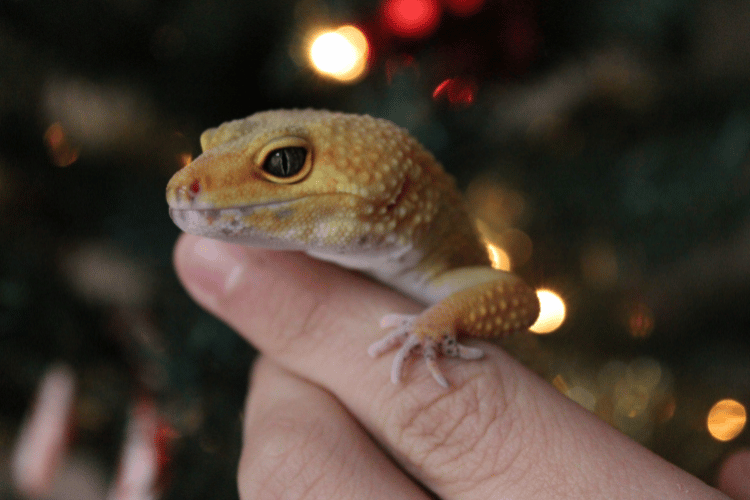
Signs Your Gecko Is Comfortable
- Relaxed, soft body posture — not stiff, not rigid, limbs moving naturally
- Calm, slow movement across your hands — exploring without urgency
- Tongue flicking — this is normal exploratory behaviour, a sign they’re investigating their environment rather than panicking
- Resting still in your palm — particularly after a few minutes of exploration, choosing to sit rather than constantly move
- Normal eye movement — alert but not darting frantically
Signs Your Gecko Is Stressed and Needs To Go Back
- Tail wagging — unlike a dog, a wagging tail in a leopard gecko signals agitation or predatory arousal, not happiness. This is one of the clearest stress signals you’ll see
- Rapid, erratic movement — frantically trying to escape your hands rather than moving at a steady pace
- Turning their body away repeatedly — consistently orienting away from you
- Mouth opening — an open mouth posture is a warning. If ignored, a leopard gecko bite may follow, though this is rarely more than a surprise rather than an injury
- Colour change — a darkening of the skin, particularly around the head, indicates stress
- Vocalisation — squeaking or chirping during handling is a clear sign to end the session immediately
If you see any of these stress signals, place your gecko back in its enclosure immediately. Never push through — doing so doesn’t “train” them to tolerate handling, it teaches them that being with you is an unpleasant experience. Patience always wins.
How To Build Trust: A Step-By-Step Taming Guide
The good news is that even a skittish leopard gecko can be tamed with a consistent approach. I’ve seen this work with my own geckos and with countless animals kept by people I’ve spoken to over the years. Here’s the process that actually works.
Step 1 — Let Them Settle (Days 1-14)
For the first two weeks after bringing a new gecko home, don’t attempt to handle them at all. Simply open the enclosure to feed, remove waste, and refresh water. Let them get used to the sight and smell of you without the added stress of being picked up.
A new gecko is dealing with a completely unfamiliar environment — new temperatures, new smells, new sounds. Adding handling on top of that is too much, too soon. Give them time to establish that the enclosure is safe before introducing yourself as a variable.
Step 2 — Introduce Your Scent
Reptiles rely heavily on scent to assess threat and familiarity. Before you start handling, place a piece of worn clothing — a sock or an old t-shirt — near the enclosure (not inside it). Your gecko will smell it through the ventilation and begin associating your scent with their safe space rather than with a predator approaching from above.
You can also let your gecko smell your hand before attempting to pick them up. Lower your hand into the enclosure palm-up and let them approach and tongue-flick your fingers before you make any attempt to lift them. This is the gecko equivalent of letting an unfamiliar dog sniff you before you pet it.
Step 3 — First Handling Sessions (Days 14-28)
Start with very short sessions — two to three minutes, no more. The goal isn’t to keep them out for long, it’s to keep the experience positive and end before any stress signals appear.
Always approach from the side, never from above. From above mimics a bird of prey — a predator approaching a leopard gecko in the wild. From the side feels far less threatening. Slide your hand under them rather than gripping from on top.
Let them walk between your hands in a continuous flow rather than holding them still. Moving hands feel more natural to a gecko than being gripped in place. Keep your movements slow and deliberate throughout.

Step 4 — Use Food As Positive Reinforcement
This is one of the fastest ways to build a positive association with being out of the enclosure. Offer a mealworm or waxworm from your palm or fingers during a handling session. Once your gecko associates your hand with food, they’ll begin approaching rather than retreating.
Don’t use this every session or they’ll come to expect a treat every time and may become nippy when one doesn’t appear. But as an occasional reinforcement during the taming phase, it works well.
Step 5 — Gradually Increase Session Length
Once your gecko is consistently calm for 2-3 minute sessions, gradually extend — adding a minute or two every few days. A fully tamed adult leopard gecko can comfortably handle 15-20 minutes per session, once a day. Don’t go beyond 20 minutes even with a well-socialised gecko — there’s a point at which even a relaxed animal becomes ready to go back.
Always end sessions on a positive note — when your gecko is still calm, not when they’re starting to show stress signals. Ending on a good note reinforces that being out with you is a pleasant experience.

When You Should NOT Handle Your Leopard Gecko
Knowing when to hold back is just as important as the handling technique itself. There are several situations where handling should be avoided entirely.
- Within 48 hours of feeding — handling after a meal can cause regurgitation, which is stressful and potentially harmful. Always wait at least 48 hours after a meal before picking them up
- During shedding — a gecko that is about to shed its skin will look dull and milky. Leave them alone completely until the shed is finished. Their skin is sensitive during this process and handling can interfere with a clean shed
- When they are unwell — a gecko showing signs of illness should not be handled. If yours is lethargic, not eating, or showing unusual symptoms, read our guide on signs your leopard gecko may be sick and consult a reptile vet
- Immediately after bringing them home — as covered above, the two-week settling period is non-negotiable
- When they are displaying clear stress signals — tail wagging, mouth gaping, erratic movement. Never push through these
- During the first hour after lights-out or before they’ve warmed up — leopard geckos are crepuscular, most active around dusk and dawn. Handling them when they’re still cold and inactive is poor timing — wait until they’ve warmed up and are moving around naturally
Does Age Affect How Quickly They Tame?
Yes — and significantly. Juveniles that are handled consistently from around 6-8 weeks of age generally become the most relaxed adults. They learn during a more neurologically flexible period and simply don’t develop the same degree of wariness toward humans.
Adult rescues or older geckos that have had limited human contact are a different challenge. They can still be tamed — I’ve seen it done — but it takes longer and requires more patience. The same process applies, just with more repetition and smaller incremental steps. Expect several months rather than several weeks for a truly settled adult that didn’t have early positive handling experiences.
It’s also worth knowing that juvenile leopard geckos are naturally more jittery than adults regardless of handling history — they’re prey animals, and small ones at that. Don’t judge a young gecko’s temperament too early. Many geckos that seemed skittish as babies become calm and easy to handle as adults once they’ve grown into their own confidence.
How Often Should You Handle A Leopard Gecko?
For a settled adult gecko, once daily is ideal — sessions of 15-20 minutes. Handling every day during the taming phase is better than infrequent long sessions; consistency is what builds trust.
That said, don’t feel obligated to handle every single day if life gets busy. Missing a day or two won’t undo the trust you’ve built. What does set things back is inconsistency over longer periods — weeks of no handling followed by daily handling can confuse an animal that has learned a predictable routine.
If you’re going through the taming process with a new gecko, aim for short daily sessions consistently rather than longer sporadic ones. Ten minutes every day beats forty-five minutes once a week every time.
Wrapping Up
Leopard geckos won’t show affection the way a mammal does, and they’ll never come running to see you. But a gecko that sits calmly in your hand, explores without panic, takes a treat from your fingers, and settles back into its enclosure without any signs of distress — that’s a gecko that trusts you. And that trust, built slowly through consistent and low-pressure interaction, is genuinely one of the more rewarding things about keeping these animals.
Geek is proof that it works. Start slow, read the signals, never force it — and you’ll get there.
Any questions about your own gecko’s behaviour? Drop them in the comments below — I read every one.
Frequently Asked Questions
Do leopard geckos like being held?
Leopard geckos don’t naturally seek out human contact, but most will become comfortable with — and some will appear to enjoy — being held once trust has been built through consistent, low-pressure handling. A relaxed gecko sitting calmly in your hands is one that has learned being with you is safe and sometimes rewarding.
How do I know if my leopard gecko is stressed during handling?
The clearest stress signal is tail wagging — unlike dogs, a wagging tail in a leopard gecko means agitation. Other signs include rapid erratic movement, mouth gaping, consistently turning away from you, and vocalisation. If you see any of these, end the session immediately and return your gecko to its enclosure.
How long should I hold my leopard gecko?
For a tamed adult gecko, sessions of 15-20 minutes once daily are ideal. During the taming phase, start with just 2-3 minutes and gradually increase as your gecko becomes more relaxed. Always end sessions on a positive note — while your gecko is still calm — rather than waiting for stress signals to appear.
When should I not hold my leopard gecko?
Avoid handling within 48 hours of feeding (to prevent regurgitation), during shedding, when your gecko is unwell, immediately after bringing them home (allow a 2-week settling period), and any time they are displaying clear stress signals like tail wagging or mouth gaping.
How do I tame a leopard gecko that doesn’t like being held?
Start with a 2-week hands-off settling period, then introduce your scent before attempting to pick them up. Begin with very short 2-3 minute sessions, always approaching from the side rather than above, and let your gecko walk between your open hands rather than gripping them. Use occasional food rewards to build positive associations. Consistency and patience over weeks to months is the key — never force handling through stress signals.
Do leopard geckos recognise their owners?
Research suggests reptiles are capable of associative learning and can distinguish familiar people from strangers based on scent and visual cues. Whether this constitutes ‘recognition’ in a meaningful sense is debated, but many experienced keepers observe that their geckos behave differently — more calmly — with their regular handler compared to strangers. This is consistent with learned habituation rather than emotional bonding.