If you’ve spotted an agama lizard — or you’re considering keeping one — the question of whether they’re poisonous is a completely reasonable one. These are bright, striking animals with vivid colours and strong jaws, and it’s natural to wonder whether that means danger.
The answer is clear: no, agama lizards are not poisonous or venomous. They pose no toxic threat to humans or pets. But there’s more worth knowing about how they defend themselves, what they can do if threatened, and — since we’re on the topic — which lizards actually are venomous.

Table of Contents
- What Is an Agama Lizard?
- Are Agama Lizards Poisonous?
- Can an Agama Lizard Bite You?
- The Poison vs Venom Distinction
- Which Lizards Are Actually Venomous?
- Agama Lizard Defences — If Not Venom, Then What?
- Are Agama Lizards Dangerous to Pets?
- How To Handle an Agama Safely
- Agama Lizards as Pets
- Wrapping Up
- Frequently Asked Questions
What Is an Agama Lizard?
Agamas (Agama spp.) are a genus of small to medium-sized lizards in the family Agamidae, native to sub-Saharan Africa. There are over 60 recognised species within the genus, found across grasslands, rocky outcrops, forest edges, and increasingly in urban environments — they adapt remarkably well to human settlements.
The species most commonly encountered outside Africa — particularly in South Florida, where they are an established invasive population — is the red-headed agama (Agama agama), also known as the rainbow agama. Males are unmistakable: bright orange-red heads, vivid blue bodies, and a territorial demeanour that makes them one of the more visually dramatic lizards you’re likely to see in a suburban Florida garden.

Agamas are diurnal reptiles — active during the day, basking in sunlight to regulate their body temperature. They’re insectivorous as a primary diet, feeding on ants, beetles, grasshoppers, and termites, though larger individuals will take small vertebrates opportunistically. For a full breakdown, see our guide on what agama lizards eat.
Are Agama Lizards Poisonous?
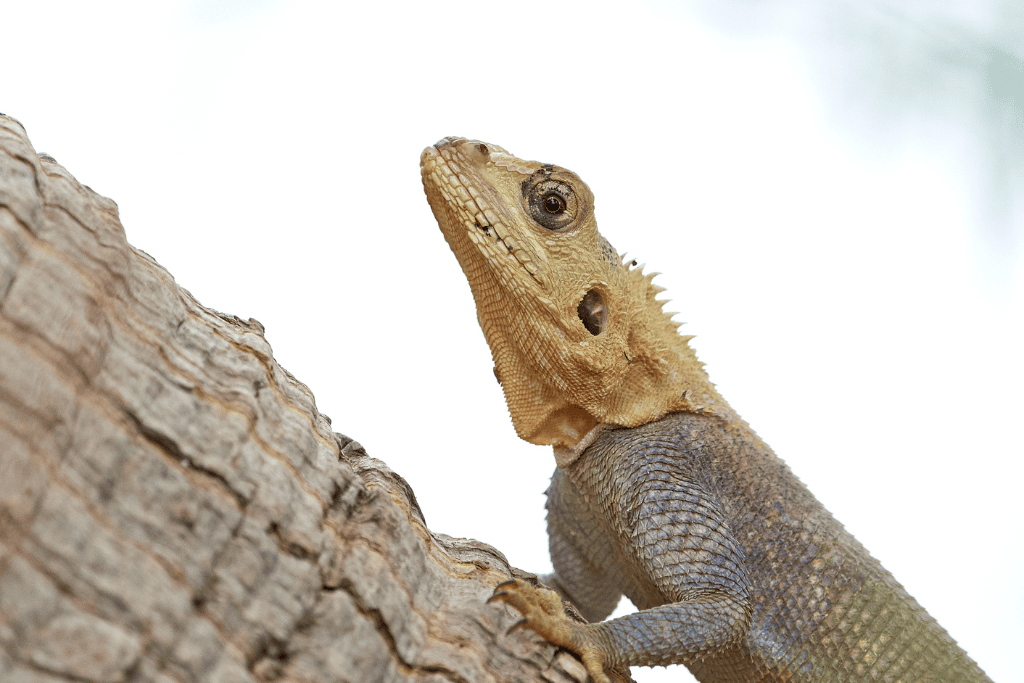
No. Agama lizards are not poisonous or venomous. They do not produce, store, or deliver any form of toxin. There are no venom glands, no toxic skin secretions, and no defensive chemical compounds of any kind associated with any agama species.
This is well established in herpetological literature. According to the peer-reviewed species accounts maintained by the Reptile Database — the primary scientific reference for reptile taxonomy and biology — no species within the genus Agama has venomous or toxic properties.
The confusion often arises from two things: their dramatic colouration, and their powerful bite. Bright colours in the animal kingdom are frequently associated with toxicity — the warning colouration of poison dart frogs is a well-known example. But in agamas, the vivid orange, red, and blue of dominant males is purely a social signal: advertising fitness to females and asserting dominance over rival males. It says nothing about toxicity.
Can an Agama Lizard Bite You?
Yes — and it’s worth knowing about, even though the answer to “are they poisonous?” is no.
Agamas have strong jaws adapted for crunching hard-bodied insects. A bite from an adult agama is painful, can break skin, and will bleed. It is not, however, venomous or toxic in any way. The risk from an agama bite is the same as the risk from any reptile bite: wound contamination from bacteria in the mouth.
Agamas are not aggressive toward humans under normal circumstances. They will bite defensively if grabbed, cornered, or handled roughly — which is true of almost every lizard species. The key situations to be aware of:
- Dominant males during breeding season are significantly more aggressive and territorial. They will posture, head-bob, and in some cases attempt to bite if they feel their territory is being threatened
- Newly captured or handled individuals will bite out of fear. Agamas that have not been socialised to human contact treat handling as a predator attack
- Wild populations in Florida are generally wary of humans rather than aggressive — they’ll flee long before they consider biting
If you are bitten, wash the wound thoroughly with soap and water, apply an antiseptic, and monitor for signs of infection. If the bite is deep or shows signs of infection within 24-48 hours, consult a healthcare provider. This is standard advice for any animal bite — not specific to agamas.
The Poison vs Venom Distinction
These terms are often used interchangeably but they mean different things, and the distinction matters when assessing risk from any animal.
- Venomous — the animal actively delivers a toxic substance through a bite, sting, or scratch. Venom is injected. Examples: Gila monster, king cobra, box jellyfish
- Poisonous — the animal is toxic when touched or consumed. The toxin is passive. Examples: poison dart frogs, many toads, some salamanders
Agamas are neither. They don’t inject venom and they’re not toxic to touch or eat. A predator eating an agama suffers no ill effects — in fact agamas are a regular prey item for snakes, birds of prey, and larger monitor lizards across their African range.
Which Lizards Are Actually Venomous?
This is a genuinely interesting area of herpetology that has evolved significantly in recent decades. A landmark 2006 study by Bryan Fry and colleagues, published in Nature, demonstrated that venom glands are far more widespread among lizards than previously understood — present in many monitor species and iguanians, not just the two traditionally recognised venomous lizards. However, venom delivery systems and their practical danger to humans vary enormously between species.
The lizards with meaningful venom capability and documented danger to humans are:


- Gila Monster (Heloderma suspectum) — native to the southwestern United States and northwestern Mexico. One of only two lizards with a well-documented venom delivery system. Venom is delivered through grooved teeth in the lower jaw. Bites are very painful and can cause significant swelling, but fatalities in healthy adults are extremely rare. The San Diego Zoo notes that the Gila monster is protected by law across most of its range
- Mexican Beaded Lizard (Heloderma horridum) — closely related to the Gila monster, found in Mexico and Guatemala. Similar venom mechanism and similar risk profile. The second of the two traditionally recognised venomous lizards
- Guatemalan Beaded Lizard (Heloderma charlesbogerti) — a critically endangered subspecies of beaded lizard with the same venom capability
- Komodo Dragon (Varanus komodoensis) — the 2009 research by Bryan Fry (University of Melbourne) confirmed that Komodo dragons possess functional venom glands that produce anticoagulant compounds. Combined with their enormous size and powerful bite, they are genuinely dangerous animals
- Monitor lizards (various Varanus species including Savannah monitor, Lace monitor, Mitchell’s water monitor, Argus monitor, and Spiny-tailed monitor) — the 2006 Fry et al. study found venom glands in multiple monitor species. The practical danger varies by species and individual, but monitor bites should always be taken seriously due to both mechanical damage and bacterial load, regardless of venom
For more on monitors, see our care guides for the Savannah monitor and the Asian water monitor.
Agama Lizard Defences — If Not Venom, Then What?
Agamas have developed several effective non-toxic defences over millions of years of evolution:
- Speed and agility — their first line of defence is simply fleeing. Agamas are fast and excellent climbers, able to reach rocky outcrops or tree trunks well before most predators can close the distance
- Threat displays — when cornered, agamas flatten their body, extend their throat, open their mouth wide to reveal the brightly coloured interior, and bob their head rapidly. For many predators this is enough of a deterrent
- Tail autotomy — like many lizards, agamas can shed their tail when grabbed by a predator. The detached tail continues to wriggle, distracting the predator while the lizard escapes. The tail regrows over time, though the regenerated version is typically cartilage rather than bone
- Bite — as a last resort, a strong bite. Not venomous, but effective at causing enough pain and surprise for a small predator to release its grip
Are Agama Lizards Dangerous to Pets?
No — with appropriate caveats. Wild agamas in Florida and other introduced populations are not toxic to cats or dogs that encounter them. They’re not venomous and their skin secretions pose no toxic risk.
The real risks are mechanical and bacterial. A cat or dog that catches and bites an agama could receive a defensive bite in return — which can cause localised pain and swelling, and carries a small risk of bacterial infection as with any animal bite wound. If your pet catches an agama and appears to be in discomfort, monitor for swelling and consult a vet if symptoms persist beyond a few hours.
Cats and dogs eating agamas is also generally not a concern from a toxicity standpoint, though it’s not a habit worth encouraging.
How To Handle an Agama Safely
Whether you’re keeping an agama as a pet or dealing with one that has entered your garden, the handling principles are the same as for any lizard:
- Approach slowly and from the side — never from above, which triggers a predator response
- Support the body fully — do not grip the tail, which may be shed as a defence mechanism
- Wear gloves for wild individuals — a wild agama that has never been handled will bite. Light leather gloves give adequate protection while allowing you to feel what you’re doing
- Avoid handling during breeding season — dominant males are significantly more defensive between March and May across most of their range
- If bitten: wash the wound immediately with soap and water, apply antiseptic, and monitor for infection. Seek medical advice if you notice swelling, redness spreading beyond the bite site, or signs of infection within 24-48 hours
Agama Lizards as Pets
Red-headed agamas are kept as pets in the United States and Europe, though they’re less common in the hobby than bearded dragons or other agamids. They’re not beginner lizards — they require a large basking enclosure, high temperatures, UVB lighting, and a live insect diet — but experienced keepers find them rewarding for their active daytime behaviour and striking appearance.
If you’re considering an agama as a pet but wondering whether a more beginner-friendly agamid might suit you better, our comparison of agamas vs bearded dragons covers the key differences in care requirements and temperament.
Wrapping Up
Agama lizards are not poisonous or venomous in any form. Their bright colours are social signals, not warnings of toxicity. They can bite if handled roughly or threatened, and that bite deserves the same basic first aid as any animal bite — but there is no venom involved and no toxic risk.
The lizards that genuinely warrant caution around venom are the Gila monster, Mexican and Guatemalan beaded lizards, Komodo dragons, and several monitor species — none of which you’re likely to encounter in a suburban garden.
Any questions about agamas or other lizard species? Drop them in the comments below.

Frequently Asked Questions
Are agama lizards poisonous?
No. Agama lizards are not poisonous or venomous. They produce no toxins, have no venom glands, and their skin is not toxic to touch or consume. Their bright colours are social signals used for territorial display and attracting mates — not a warning of toxicity.
Is the agama lizard venomous?
No. No species within the genus Agama has venomous capability. They have strong jaws adapted for catching insects and can deliver a painful bite if threatened, but the bite contains no venom. The bite risk from an agama is purely mechanical, not chemical.
Does the agama lizard bite?
Yes — agamas can and will bite defensively if grabbed, cornered, or handled roughly. The bite is painful and can break skin, but is not venomous. Wash any bite wound with soap and water, apply antiseptic, and monitor for infection. Dominant males are more likely to bite during breeding season.
What do agama lizards eat?
Agamas are primarily insectivorous, feeding on ants, beetles, termites, grasshoppers, and other insects. Larger individuals will occasionally eat small vertebrates. They do not eat vegetation as a significant dietary component, unlike their relatives the bearded dragons.
What lizards are actually venomous?
The Gila monster and Mexican beaded lizard are the two species with traditionally recognised venom delivery systems. Research published in Nature (Fry et al., 2006) confirmed that venom glands are also present in Komodo dragons and several monitor species. None of these are common garden lizards — the agama lizards encountered in the wild or kept as pets are not venomous.
Are agama lizards dangerous to cats and dogs?
Not from a toxicity standpoint — agamas are not toxic to pets. A cat or dog that catches an agama might receive a defensive bite, which should be monitored for infection as with any animal bite wound. Consult a vet if symptoms persist. Eating an agama poses no toxic risk to pets.