Choosing the right enclosure is the single most important setup decision you’ll make for a bearded dragon. Everything else — lighting, heating, substrate — depends on having the right sized, well-ventilated space to work with.
The most common mistake new owners make is buying an enclosure that’s too small. The old guidance of a 40-gallon tank for an adult beardie has been largely revised by the reptile keeping community — adult bearded dragons do best in a 4x2x2 foot (120 gallon) enclosure, and buying one from the start saves you upgrading as they grow.
This guide covers what to look for in a bearded dragon enclosure, which size to get at each life stage, and the best options currently available with honest notes on each.
Table of Contents
- What Size Enclosure Does a Bearded Dragon Need?
- What To Look For in a Bearded Dragon Enclosure
- Best Bearded Dragon Enclosures
- Setting Up Your Enclosure Correctly
- Frequently Asked Questions
- What size enclosure does a bearded dragon need?
- Is a 40 gallon tank big enough for a bearded dragon?
- What is better for bearded dragons — glass or PVC enclosure?
- Can I use a fish tank for a bearded dragon?
- How much does a bearded dragon enclosure cost?
- Do I need a screen top for a bearded dragon enclosure?
What Size Enclosure Does a Bearded Dragon Need?
This is where most new owners go wrong. Pet stores often recommend a 40-gallon tank as a starting point — and while that works for hatchlings and young juveniles, it’s inadequate for an adult bearded dragon that can reach 24 inches in length.
| Age / Size | Minimum Enclosure | Recommended |
|---|---|---|
| Hatchling (0–3 months) | 20 gallon (24x12x12″) | 40 gallon (36x18x18″) |
| Juvenile (3–12 months) | 40 gallon (36x18x18″) | 75 gallon (48x18x18″) |
| Adult (12+ months) | 75 gallon (48x18x18″) | 120 gallon (48x24x24″) ← 4x2x2 |
The 4x2x2 foot (120 gallon) enclosure is the current community-recommended adult size and what most experienced keepers use. The extra floor depth — 24 inches rather than 18 — makes a meaningful difference to your beardie’s ability to establish a proper temperature gradient, which is essential for thermoregulation and digestion.
If budget allows, start with the adult enclosure from day one. Your hatchling will have more space than they initially need, but they’ll grow into it quickly — most bearded dragons reach adult size by 18 months — and you avoid the disruption and cost of upgrading the enclosure mid-way through their development. For the full habitat setup guide including lighting, heating and substrate, see our bearded dragon habitat guide.
What To Look For in a Bearded Dragon Enclosure
Front-Opening Doors
Front-opening enclosures are significantly better than top-opening for bearded dragons. Approaching a beardie from above mimics the movement of a predator — it triggers a stress response that you’ll notice as a flattened body, darkened beard, or an attempt to flee. Front access allows you to approach at eye level, which is far less threatening. After using both designs, front-opening is always the better choice for a species that spends so much time being observed and handled.
Screen or Mesh Top
A mesh top is essential. Bearded dragons need high-output UVB lighting, and most quality UVB bulbs (particularly T5 HO tubes) are designed to be mounted above a mesh screen that the UV penetrates through. A solid glass or plastic top blocks UVB entirely — a critical problem for a species that depends on UVB to synthesise Vitamin D3 and maintain bone health. Check that the mesh is fine enough to prevent your beardie’s claws from catching on it but open enough for adequate light and heat penetration.
Waterproof Base
A sealed, waterproof base is important for day-to-day hygiene and longevity. Bearded dragons defecate in their enclosure and water dishes get tipped — a non-waterproof base absorbs moisture, warps, and becomes a bacterial breeding ground. All the enclosures recommended below have waterproof bases.
Security
A lock or secure latch on the doors matters for two reasons: preventing escape attempts from a curious beardie, and preventing access from other household pets — particularly cats, which can open unsecured sliding doors. A key lock or sturdy latch mechanism is worth having.
Build Material — Glass vs PVC
The two main materials you’ll encounter are tempered glass and PVC panel enclosures.
Glass enclosures provide excellent visibility, are easy to clean, and are widely available. The trade-off is weight — a large glass enclosure is heavy and difficult to move — and glass retains heat less efficiently than PVC, which can make maintaining a proper temperature gradient slightly more demanding in larger sizes.
PVC panel enclosures are lighter, retain heat more efficiently (which often reduces heating costs), and are the preferred choice of many experienced keepers for adult animals. The trade-off is that visibility through PVC panels is generally slightly less clear than tempered glass, and PVC enclosures are typically more expensive.
For most owners, a quality glass enclosure at 4x2x2 is the practical choice — widely available, well-priced, and excellent for viewing. PVC is worth considering if you’re building a long-term setup and want better heat retention.
Avoid Starter Kits
Starter kits that bundle an enclosure with lights, substrate, and accessories look convenient but consistently underdeliver. The bundled UVB bulbs are almost always inadequate compact fluorescents rather than the T5 HO tubes that bearded dragons need, the thermometers are analogue dial types that are notoriously inaccurate, and the enclosures themselves are often on the smaller side. You’ll spend more money replacing the kit components than if you’d bought quality items individually from the start.
Best Bearded Dragon Enclosures
1. Best Overall Adult Enclosure: 120 Gallon 4x2x2 Glass Terrarium
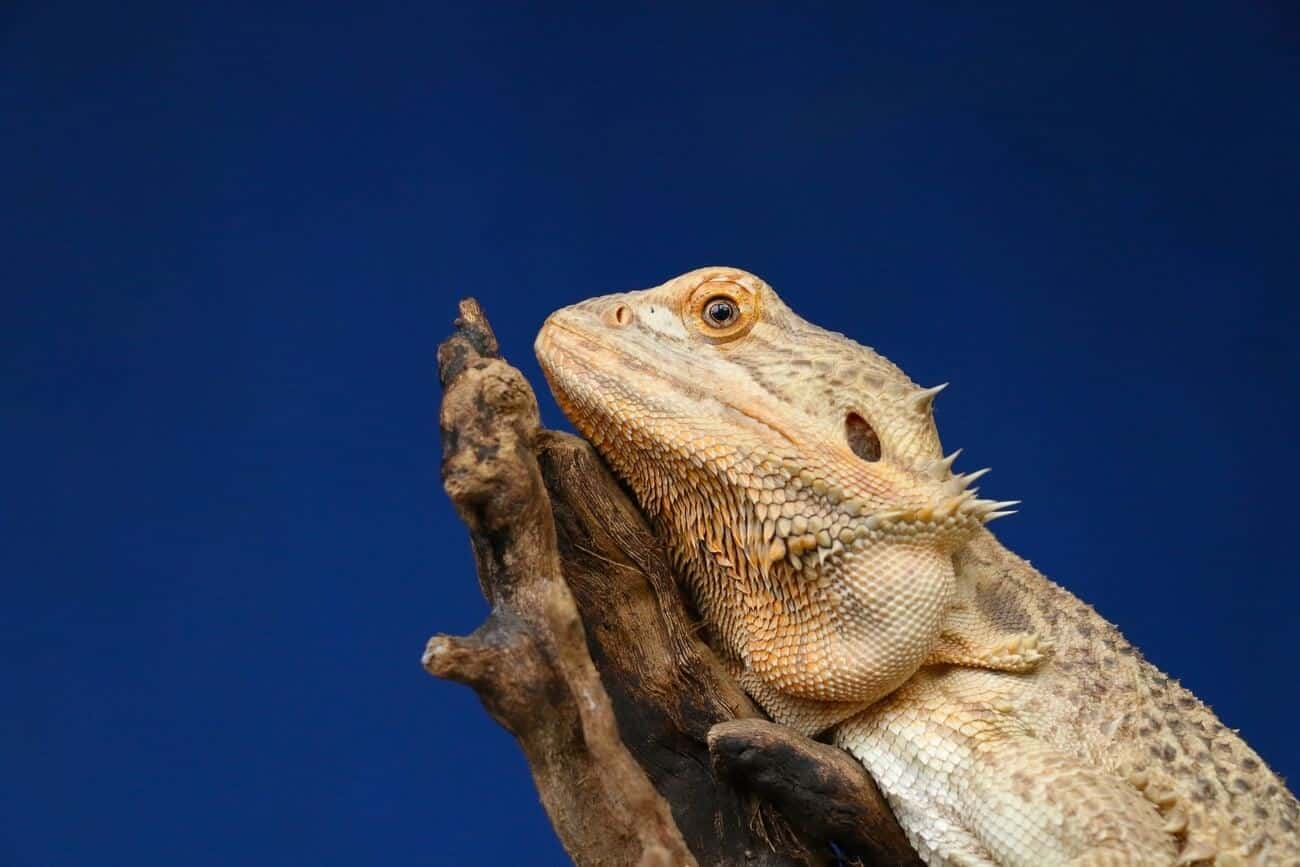
The 4x2x2 foot (48x24x24 inch) glass terrarium has become the standard recommendation for adult bearded dragons. It provides enough floor space to establish a proper temperature gradient from basking zone to cool side, enough height for a hammock and some vertical enrichment, and front sliding doors for easy access.
The 120 Gallon 4x2x2 Bearded Dragon Tank is a solid example of what’s currently available — tempered glass panels, front sliding doors with lock, full mesh top for UVB penetration, raised waterproof base, and cable ports for wiring. It assembles without tools in under 20 minutes and ships flat-packed.
Best for: Adult bearded dragons 12+ months. Suitable from juvenile stage if budget allows buying once.
What to note: At this size, you’ll want to measure your space carefully — 48 inches is 4 feet of continuous wall space. Check that wherever you position it can support approximately 80–120kg when fully furnished with substrate, décor, and lighting fixtures.
Pros: Correct adult size, full mesh top, front opening, waterproof base, locks
Cons: Heavy when fully set up, needs adequate shelf or stand support
2. Best Budget Option: REPTI ZOO 40 Gallon (36x18x18)
If you’re starting with a young juvenile or working within a tighter budget, the REPTI ZOO 36x18x18 glass terrarium is a reliable entry point. REPTI ZOO have been making quality reptile enclosures for years and their 40-gallon glass terrarium is well-built, genuinely waterproof, and has the raised bottom frame for a substrate heater underneath — a design detail many cheaper tanks miss.
Browse the REPTI ZOO 36x18x18 terrarium on Amazon for current pricing and availability. The range has several variants including hinged front doors and sliding front doors — the hinged front door version is preferable for regular access.
Best for: Hatchlings and juveniles up to 12 months, or as a budget first enclosure to upgrade from later.
What to note: This is too small for a fully grown adult beardie — plan to upgrade to a 4x2x2 at around 12–18 months. Think of it as a starter enclosure.
Pros: Affordable, reliable build quality, good ventilation, raised base for heat mat
Cons: Undersized for adults, will require upgrade
3. Best for Hatchlings: Exo Terra 24x18x12 All Glass Terrarium
Exo Terra is one of the most trusted names in the reptile enclosure market. Their 24x18x12 inch glass terrarium is an excellent hatchling enclosure — well-built, with excellent front-door access, a closable inlet for cables, a removable screen top, and Exo Terra’s signature raised “natural substrate” rim that creates a lip to hold substrate in place. The glass is high-clarity, making it easy to observe a small hatchling.
Browse the Exo Terra 24x18x12 terrarium on Amazon for current options. This size is genuinely ideal from hatch to around 3–4 months — at which point most beardies are large enough to move to a 40-gallon.
Best for: Hatchlings 0–4 months. Also useful as a quarantine or hospital enclosure for adults.
Pros: Excellent build quality, great visibility, good ventilation
Cons: Only appropriate for hatchlings — very small for anything older
4. Best Premium Option: 4x2x2 PVC Panel Enclosure
For keepers who want the best long-term adult setup, a PVC panel enclosure is worth the higher upfront cost. PVC retains heat significantly better than glass — meaning your heating equipment works more efficiently and you’re less likely to lose temperature in a cold room. It’s also much lighter than an equivalent glass tank, making repositioning easier.
The most popular PVC option on Amazon is the 4x2x2 PVC bearded dragon enclosure — look for tempered glass sliding doors (not acrylic, which scratches), a stainless steel mesh top, and aluminium frame construction. Several brands offer this format at varying price points.
Best for: Adult bearded dragons, experienced owners, keepers in colder rooms or climates.
Pros: Superior heat retention, lighter weight, long-lasting construction
Cons: More expensive, slightly less clear visibility than glass
Setting Up Your Enclosure Correctly
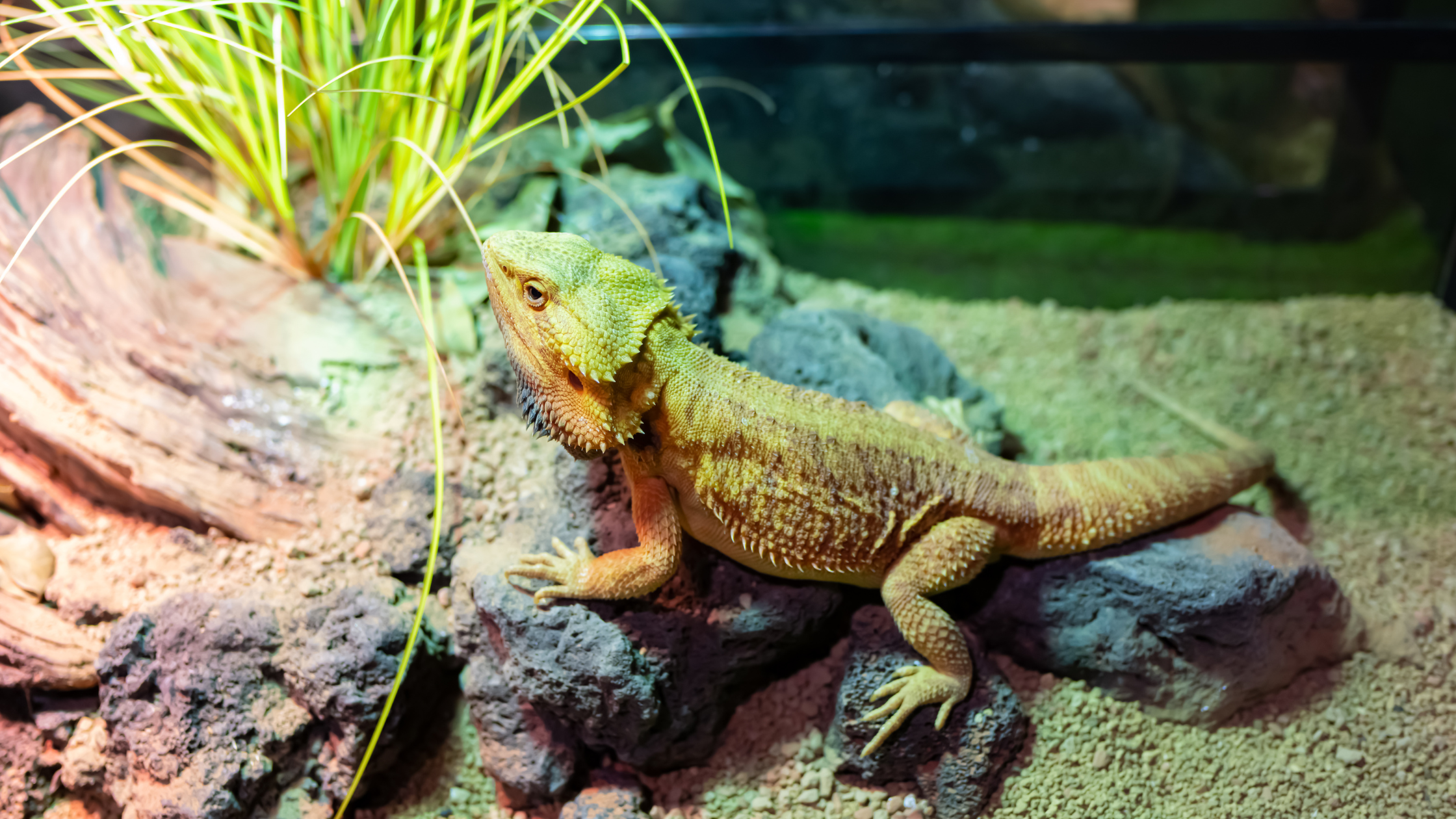
Once you have the right enclosure, getting the setup right is what determines how well your beardie thrives. The three non-negotiables are temperature gradient, UVB lighting, and substrate.
Temperature Gradient
Bearded dragons need to thermoregulate — moving between warm and cool zones throughout the day to regulate their body temperature and aid digestion. This requires a meaningful temperature difference across the enclosure:
- Basking spot: 100–110°F (38–43°C) — measured at the surface where your beardie sits, not in the air
- Warm side ambient: 85–90°F (29–32°C)
- Cool side: 75–80°F (24–27°C)
- Night-time: No lower than 65°F (18°C)
Use a digital thermometer with a probe — never rely on analogue dial thermometers, which are consistently inaccurate. An infrared temperature gun is the most accurate way to check surface basking temperature and costs very little.
UVB Lighting
UVB is not optional for bearded dragons. Without it, they cannot synthesise Vitamin D3 regardless of dietary supplementation, which leads to metabolic bone disease — the most common preventable health problem in captive bearded dragons. A T5 HO UVB tube is the current standard recommendation — a Arcadia 12% or Zoo Med Reptisun 10.0 T5 HO placed above the mesh top, covering at least half the enclosure length. Replace the bulb every 6–12 months even if it still emits visible light. See our UVB lighting guide for specific recommendations.
Substrate
Loose particle substrates — particularly sand — are controversial for bearded dragons due to ingestion and impaction risk, particularly for juveniles. For adults, a bioactive substrate using a mix of organic topsoil, clay, and sand can work well in a properly managed setup. For beginners or juveniles, tile, paper towels, or reptile carpet are the safest and easiest to clean options.
Frequently Asked Questions
What size enclosure does a bearded dragon need?
Adult bearded dragons need a minimum of 75 gallons (48x18x18″), with 120 gallons (4x2x2 ft / 48x24x24″) being the current community recommendation. The extra 6 inches of floor depth in a 4x2x2 makes a meaningful difference to establishing a proper temperature gradient. Juveniles can start in a 40 gallon (36x18x18″) and hatchlings in a 20–40 gallon.
Is a 40 gallon tank big enough for a bearded dragon?
A 40 gallon tank (36x18x18″) is adequate for juveniles up to around 12 months but too small for a fully grown adult bearded dragon. Adult beardies reach 18–24 inches and need a 4x2x2 foot (120 gallon) enclosure to thermoregulate properly and have adequate space to move. Keeping an adult in a 40 gallon long-term is associated with stress behaviours including glass surfing.
What is better for bearded dragons — glass or PVC enclosure?
Both work well. Glass enclosures provide excellent visibility and are widely available at lower price points. PVC enclosures retain heat better (making heating more efficient and cost-effective), are lighter, and are preferred by many experienced keepers. For most new owners, a quality 4x2x2 glass enclosure is the practical starting point. PVC is worth considering for a long-term permanent setup.
Can I use a fish tank for a bearded dragon?
Not ideally. Standard fish tanks (aquariums) are designed for vertical water pressure and don’t have the front-opening doors, mesh tops, or raised bases that reptile terrariums provide. The biggest issue is the lid — a solid glass aquarium lid blocks UVB lighting completely, which is harmful to bearded dragons. A purpose-built reptile enclosure is always the better choice.
How much does a bearded dragon enclosure cost?
A quality 40 gallon glass terrarium for a juvenile typically costs $100–$200. A 4x2x2 adult glass enclosure runs $200–$400 depending on brand and features. PVC 4x2x2 enclosures are typically $350–$600+. Budget for a stand or sturdy surface to position the enclosure on as well — particularly important for the 120 gallon sizes which are heavy when fully furnished.
Do I need a screen top for a bearded dragon enclosure?
Yes. A mesh or screen top is essential for two reasons: it allows UVB and infrared light to penetrate the enclosure from overhead bulbs (solid glass or plastic tops block UVB), and it allows heat to escape upward and prevents dangerous temperature build-up. All the enclosures recommended in this guide have mesh tops.