Bearded dragons are more intelligent than most people give them credit for, and a basic enclosure with nowhere to go and nothing to do leads to boredom, inactivity, and weight gain over time. I’ve kept bearded dragons for years and the difference a well-enriched setup makes to their daily behaviour is genuinely noticeable — a beardie that has climbing opportunities, interaction with their owner, and the occasional novel object to investigate is simply a more active and engaged animal.
This guide covers the best toys for bearded dragons, what makes them worth having, and a set of activities you can do with your beardie that don’t require buying anything at all.

Table of Contents
Why Enrichment Matters for Bearded Dragons
In the wild, bearded dragons spend their days exploring territory, hunting prey, basking on elevated rocks, and interacting with their environment in ways that a standard enclosure simply can’t replicate. A captive beardie without enrichment is essentially in a featureless box — everything they need is provided, but there’s nothing to do.
The consequences are practical, not just philosophical. Inactive bearded dragons gain weight easily, and obesity shortens their lifespan and creates health problems just as it does in any animal. Mental stimulation is also genuinely important — under-stimulated beardies can develop repetitive glass-surfing behaviour that is a stress indicator. Providing regular enrichment through toys, habitat additions, and interactive activities addresses both.
You don’t need to spend a lot of money. Some of the most effective enrichment options are free. But the toys below are worth having, and most will last for years.
The Best Bearded Dragon Toys
1. Hammock
A hammock is the single most universally useful addition to a bearded dragon enclosure. Every beardie owner should have one — it’s a basking platform, a resting spot, a climbing accessory, and a place to observe the room, all in one. The textured seagrass surface also helps with shedding, giving your beardie something to rub against when old skin is coming away.
The Niteangel Bearded Dragon Hammock is the most reliable option consistently available — hand-woven seagrass, strong suction cups, and sized for adult bearded dragons. It attaches to the glass panel inside the enclosure and can be repositioned at different heights depending on where your basking light is positioned.
Seagrass hammocks are preferable to mesh alternatives — mesh can catch claws and cause toe injuries. Make sure to check the suction cups regularly and replace them if they start losing their grip.
2. Reptile Hide
Hides are often overlooked as enrichment but are genuinely important for a beardie’s wellbeing. In the wild, bearded dragons use rock crevices and tight spaces to feel safe, thermoregulate, and sleep. A hide in the enclosure gives them access to that same behaviour and somewhere to retreat when they want privacy or feel overwhelmed.
Look for a hide sized so your beardie can just fit inside — too large and it won’t feel secure, too small and they’ll ignore it. Moulded resin designs that look like rocks or bark are the most durable and easiest to clean. Browse bearded dragon hides on Amazon for current options across different sizes.

3. Cat Wand
Cat wands are excellent interactive toys for bearded dragons and one of the most entertaining things you can do with your beardie at home. Wave the dangling toy in front of them and most beardies will track it, stalk it, and attempt to catch it. It triggers their natural hunting response and gets them moving without requiring anything elaborate.
Use a wand with a simple, solid toy on the end rather than feathers or loose parts. Beardies will attempt to eat whatever they can catch, and feathers or small fabric pieces create an impaction risk. Browse cat wand toys on Amazon — most are very affordable and a standard teaser wand works perfectly.
A few minutes of wand play a couple of times a week is ideal. Watch for signs that your beardie is tiring — a beardie that stops responding and retreats to bask has had enough for that session.
4. Play Ball
Not all bearded dragons will engage with a ball — some will ignore it completely — but many will push it with their snout, headbutt it, or follow it around the floor. It’s worth trying because it costs almost nothing and provides genuine physical activity for the beardies that take to it.
The best option is a ping pong ball or a small, lightweight plastic ball. It needs to be light enough for them to move but not so small it’s a swallowing hazard. Let them interact with it on a flat, open surface rather than inside the enclosure where it will get stuck. Don’t leave a ball in the enclosure unsupervised.
5. Tunnel
Bearded dragons have a natural inclination to explore confined spaces — it replicates the burrow and crevice behaviour of their wild counterparts. A tunnel gives an outlet for this and provides a novel space to investigate.
The most useful tunnels for beardies are those designed for cats or small rodents — large enough to crawl through but enclosed enough to feel interesting. Use tunnels outside the enclosure in a supervised play area rather than permanently inside the tank where they take up basking space. You can toss a few feeder insects inside to encourage exploration. Browse collapsible pet tunnels on Amazon — look for one at least 30cm in diameter.
6. Floaties (for Bath Time)
If your beardie tolerates or enjoys baths, floaties add something to interact with in the water. For beardies that are nervous about baths, a float gives them something solid to cling to which can make the experience significantly less stressful — they’ll perch on it rather than frantically trying to climb out of the tub.
Bearded dragon baths should be in lukewarm water (95–100°F) and last 15–20 minutes. Never use chlorinated water. A small inflatable ring or foam float works well — just ensure it’s non-toxic and has no small parts that could be ingested. Browse small animal floaties on Amazon for suitable options.
7. Crinkle Ball
Crinkle balls — small spheres made from mylar or crinkly plastic film — produce a crinkling noise when moved that many beardies find genuinely stimulating. The sound activates their curiosity and you’ll often see them approaching cautiously to investigate. Most are sold as cat toys and cost almost nothing.
Scrunch one in your hand a few times to produce the noise and set it down near your beardie. If they don’t react, try placing them on top of it so the crinkle happens underfoot — this usually triggers a more engaged response. Browse mylar crinkle ball toys on Amazon.
8. Bridge or Climbing Platform
A bridge or elevated platform inside the enclosure adds three-dimensional space to what is otherwise a flat floor environment. Bearded dragons will climb bridges to reach elevated positions, bask on top of them, and use arch-shaped designs as additional hides underneath. It’s one of the most natural enrichment additions you can make since it mimics the rock formations beardies use in the wild.
Choose a bridge made from moulded resin or natural wood that’s easy to clean and free of sharp edges. Browse reptile bridges and platforms on Amazon — check that the size is appropriate for an adult beardie before buying.
9. Mirror
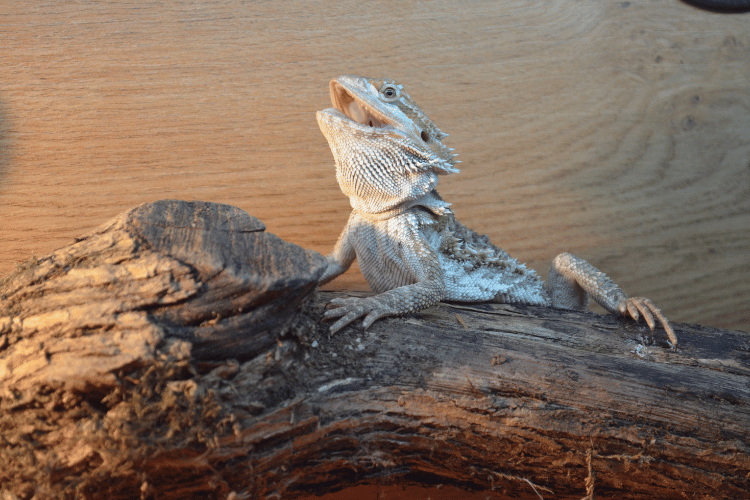
A mirror placed against the enclosure wall works by triggering your beardie’s territorial response — they’ll see their own reflection and typically react as if encountering another beardie. Responses vary by individual: some will darken their beard and display, others will cautiously approach to investigate.
Use the mirror in short sessions of 10–15 minutes and then remove it — leaving it in place permanently causes chronic stress as they can never resolve the perceived intrusion. If your beardie becomes genuinely distressed (persistent black beard, refusing to eat, frantic movement), retire the mirror. For beardies that engage with curiosity rather than aggression it makes for entertaining interaction.
10. Feeder Ball (DIY)
A feeder ball turns mealtime into a puzzle. Fill a lightweight wiffle ball with live insects, cover most of the holes with tape, and leave one or two open. Your beardie has to work out where the opening is to access the insects inside.
It’s one of the highest-value enrichment activities you can provide because it combines physical activity, problem solving, and feeding reward — replicating the mental effort of hunting rather than just eating from a bowl. Use feeder insects your beardie already eats — crickets work well because their movement inside the ball adds to the excitement.
11. Laser Pointer
A laser pointer moves in a way that strongly mimics an insect, and most bearded dragons will give immediate chase. It’s one of the fastest ways to get a sedentary beardie moving. A few minutes of laser play two or three times a week is a good way to encourage exercise in beardies that aren’t otherwise very active.
Two important rules: never point the laser at your beardie’s face or eyes — the concentrated light causes retinal damage — and keep sessions short. Bearded dragons will eventually learn that the dot isn’t a real insect, and over-use makes them less responsive. Keep it under five minutes per session. Any standard laser pointer works fine.
Enrichment Activities to Do With Your Bearded Dragon
These activities don’t require buying anything — they’re about spending time with your beardie and providing novel experiences that improve their quality of life.
Taking Them for a Walk
A walk outside is one of the best things you can do for your bearded dragon — natural sunlight provides genuine UVB (far superior to any bulb), the outdoor environment gives a huge range of novel stimuli, and moderate exercise does both of you good.
You need a proper harness to do this safely. The ADOGGYGO Bearded Dragon Dinosaur Wing Harness comes in S/M/L sizes, fits baby through adult beardies, is made from soft leather that won’t irritate skin, and comes with a nylon leash. It’s one of the most popular harnesses available with thousands of reviews — the wing design is an added bonus that most owners find endearing. Measure your beardie’s chest girth before ordering to get the right size.
On your first few walks your beardie may be reluctant — stay on grass or a clean paved surface, avoid other animals, and keep the outing short until they’re comfortable. By the third or fourth walk most beardies associate the harness with the outdoor adventure and accept it readily.

Swimming
Bearded dragons are capable swimmers. Many enjoy it — particularly if they’ve been introduced to water gradually and have positive associations with bath time. A shallow plastic storage tub or a small kiddie pool works well — enough water for them to swim but shallow enough that they can easily stand if they want to.
Always use clean dechlorinated water at 95–100°F. Never leave your beardie unsupervised in water. If they show stress immediately — frantically trying to exit, dark beard, gasping — end the session. If they seem comfortable and are swimming naturally, you can let them explore for 10–15 minutes.
Window Watching
Bring your beardie to a window and let them observe the outside world. Many beardies are genuinely fascinated by the movement of birds, insects, and people from a safe vantage point. If they seem relaxed and engaged, you can position their enclosure close to a window to give them this view throughout the day.
Watch for stress signs — head bobbing, glass surfing, trying to flee — which indicate the stimulation is too intense for that individual. Some beardies love it; some find it overwhelming. Respond to what your individual animal shows you.
Screen Time
Many bearded dragons will fixate on a television or tablet screen, particularly when there is movement — insects, birds, or other animals moving across the screen. Putting on a nature documentary near their enclosure or bringing your tablet close to them is a simple way to provide novel visual stimulation.
YouTube has playlists specifically made for reptiles — videos of insects moving are particularly effective. After showing your beardie insect videos, follow up with a real feeding session to give the experience a satisfying resolution.
Handling and Cuddle Time
Regular handling is itself a form of enrichment. A bearded dragon that spends time outside its enclosure on a regular basis experiences novel temperatures, textures, scents, and visual stimuli that simply aren’t available inside the tank. Even a beardie sitting on your chest or shoulder while you watch television is getting more environmental variation than sitting on their substrate alone.
The benefits compound with consistency. Beardies that are handled regularly become progressively calmer and more tolerant of interaction. Those that are rarely handled become increasingly reactive to it. Daily or near-daily handling sessions of 15–30 minutes make a meaningful difference to temperament over time. For more on handling technique, see our guide on bearded dragons and handling.
Foraging Feeding
Instead of placing feeders directly in a bowl, scatter them across a clean paved surface or a chemical-free grass area and let your beardie hunt them down naturally. This is one of the highest-value activities you can do because it triggers the complete hunting sequence — tracking, stalking, and catching prey — rather than the passive feeding that a bowl provides.
Only do this with gut-loaded feeder insects you’ve purchased — never let your beardie eat wild insects, which may carry pesticides, parasites, or pathogens. Supervise the session to ensure all insects are caught or retrieved after feeding.
Wrapping Up
A well-enriched bearded dragon is more active, maintains a healthier weight, and is more engaged with its environment and with you. None of the above requires a large investment — a hammock and a hide make a significant difference to the basic enclosure setup, a harness opens up outdoor walks, and many of the most effective enrichment activities cost nothing at all.
Start with the hammock and the walking harness if you’re choosing just two things — they provide the most consistent enrichment benefit of anything on this list.
Questions about enrichment or specific toys — leave them in the comments.
Frequently Asked Questions
What toys do bearded dragons like?
Bearded dragons respond well to hammocks (for basking and climbing), cat wands (interactive hunting play), tunnels (exploring confined spaces), and balls (pushing and investigating). Not every beardie will engage with every toy — try a few and see what your individual animal responds to. The best enrichment toys are ones that trigger natural behaviours like hunting, climbing, or exploring.
Can bearded dragons play with cat toys?
Yes. Cat wands, crinkle balls, and small lightweight balls all work well as bearded dragon toys. Avoid any cat toy with feathers, loose fabric, or small parts that could be ingested — beardies will attempt to eat whatever they can catch. Stick to solid, simple toys with no detachable parts.
Do bearded dragons need enrichment?
Yes. Without enrichment, captive bearded dragons become inactive, gain weight, and can develop stress behaviours like glass surfing. Enrichment — through toys, handling, outdoor time, and habitat additions — helps maintain a healthy weight, provides mental stimulation, and improves their overall quality of life.
Can I use a laser pointer with my bearded dragon?
Yes, in short sessions. Most beardies will actively chase a laser dot. Keep sessions under five minutes, use it 2–3 times per week at most (overuse leads to boredom), and never point the laser at your beardie’s face or eyes as the concentrated light causes retinal damage.
Do bearded dragons need a hammock?
Not strictly — but a hammock is one of the most universally useful accessories you can add to a bearded dragon enclosure. It provides an elevated basking spot, a resting platform at different heights, a climbing opportunity, and a rough surface that helps with shedding. Most bearded dragons use their hammock daily once introduced to it.
Can bearded dragons go for walks?
Yes, with a properly fitted harness and leash. A walk outside provides natural UVB sunlight (superior to artificial bulbs), novel stimuli that enrich your beardie’s day, and light exercise. Introduce the harness gradually — most beardies accept it fully by the third or fourth outing. Avoid areas with dogs or other predators, and monitor temperature carefully.