Travelling with a bearded dragon is straightforward once you understand what they need — and what they genuinely don’t cope well with. I’ve travelled with my beardie Draco on a number of occasions, from short vet visits to longer trips, and the difference between a calm gecko and a stressed one comes down almost entirely to temperature management and keeping disruption to a minimum.
This guide covers everything: choosing the right carrier, managing heat on the road, car travel, overnight stays, finding pet-friendly accommodation, and the reality of airline travel with a bearded dragon.
Table of Contents
Before You Leave: What To Prepare
Choose the Right Carrier
A hard-sided carrier is the only appropriate choice for transporting a bearded dragon. Hard plastic cat carriers or purpose-built reptile travel containers maintain temperature better, provide structural protection, and are easier to secure in a vehicle than soft-sided bags.
Size the carrier appropriately — your beardie should be able to turn around comfortably but shouldn’t have so much space that they’re thrown around during movement. Line the bottom with clean towels or reptile carpet for grip and cushioning. Add a small hide if the carrier is large enough — having somewhere to retreat reduces stress significantly.
Pre-Trip Vet Check
For any trip longer than a day, or if your beardie has existing health issues, a pre-travel vet check is worth scheduling. Travel is physiologically stressful — it suppresses immune function temporarily — and a beardie that’s carrying a low-grade infection or early respiratory issue may not show obvious symptoms at home but can deteriorate quickly under travel stress. Better to know before you leave.
Also confirm your destination’s regulations if you’re crossing state or international borders. Some US states have restrictions on transporting certain reptile species, and international travel requires health certificates and import documentation that vary by country.
What To Pack
- Food: Pre-portioned portions of their usual diet — feeder insects in a sealed container, fresh greens in a small bag. Pack more than you think you need; delays happen
- Small spray bottle: For misting and hydration during longer trips
- Digital thermometer: Non-negotiable. You need to be able to monitor carrier temperature accurately throughout the trip
- Heat source: Microwavable heat pad, hand warmers, or a small USB-powered heat mat — always wrapped in a towel to prevent direct contact
- Paper towels and small bags: For waste cleanup
- A worn item of clothing: A t-shirt or sock you’ve recently worn placed in the carrier — your scent is a genuine comfort to a habituated beardie
- Basic first aid: Diluted iodine solution and gauze — for minor injuries if they occur
Temperature Management on the Road
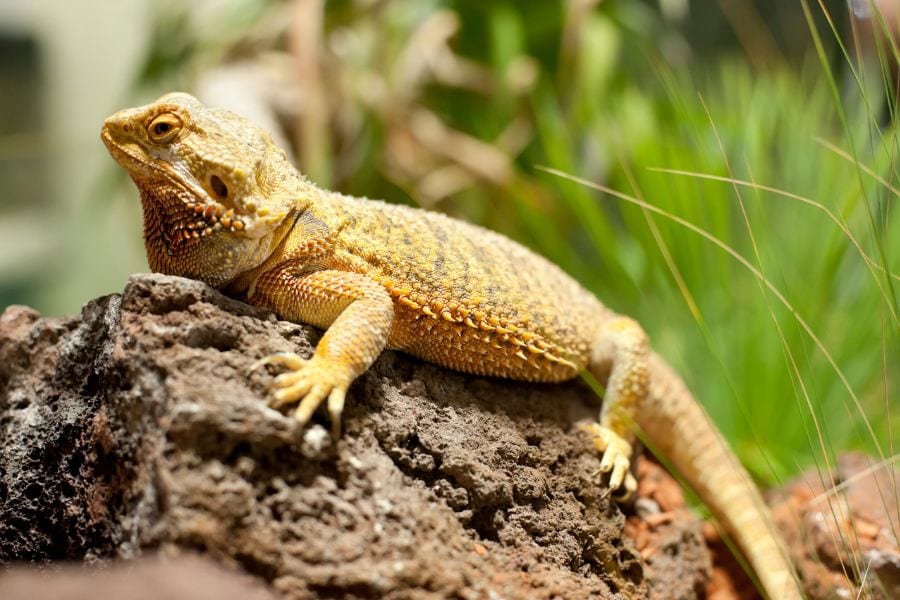
This is the single most important factor in safe beardie travel. Bearded dragons are ectotherms — they rely entirely on external heat sources to regulate their body temperature. A carrier that drops below 65°F will leave your beardie cold, lethargic, and unable to digest properly. A carrier that exceeds 105°F in direct sun creates a genuine heat emergency within minutes.
Target carrier temperature during travel: 75–85°F. Monitor with a thermometer placed inside the carrier throughout the trip — not just at the start.
Keeping the Carrier Warm
- Microwavable heat pads (Snuggle Safe or similar) — heat for 6–8 hours, place wrapped in a towel under one half of the carrier so your beardie can move away from it if needed
- Hand warmers — work in a pinch but need checking every 30–45 minutes as they can overheat. Always wrap in a towel and never place directly against the carrier wall
- Vehicle heating — setting the car to a warm, stable temperature is the simplest solution for car travel. Aim for the vehicle interior to sit at 75–80°F
- Insulating the carrier — wrapping the carrier in a fleece blanket retains heat effectively in cold weather, while still allowing ventilation through the carrier’s own air holes
Preventing Overheating
Overheating is a more acute danger than cold. A closed car in summer sun can reach dangerous temperatures within 10–15 minutes — never leave your beardie unattended in a parked vehicle in warm weather, even with windows cracked.
During travel, keep the carrier out of direct sunlight coming through windows. A small battery-powered fan directed at one side of the carrier helps in warm weather. If the temperature inside the carrier approaches 95°F, act immediately — move to a shaded area, increase ventilation, and mist the carrier lightly with room-temperature water.
Car Travel: Practical Guide
During the Drive
- Secure the carrier — use a seatbelt through the carrier handle or place it in the footwell behind the passenger seat where it won’t move. A carrier that slides around during cornering is a significant stress source
- Minimise handling — resist the urge to take your beardie out during the journey. The combination of movement, noise, and unfamiliar scents is already taxing. Handling adds another layer of stress on top of that
- Keep the car environment calm — loud music and rapid temperature changes from air conditioning cycling affect the carrier environment. Moderate music and stable vehicle temperature help
- Check temperature every 60–90 minutes — a quick glance at the thermometer at each stop is all it takes
Feeding During Travel
For trips under 4 hours, skip feeding entirely — a beardie that hasn’t eaten for a few hours is fine, and feeding on a moving vehicle risks regurgitation. For longer journeys, offer greens only at rest stops rather than live insects. Live insects in a moving carrier are stressful for the beardie and difficult to contain. Hold off on insects until you’ve reached your destination and your beardie has settled.
Offer a light misting or a shallow water dish at each rest stop. Many beardies won’t drink during travel, but providing the opportunity is good practice for trips over 3–4 hours.
How Often to Stop
Every 2 hours is a reasonable stopping frequency — it allows you to check temperature, offer water, and give yourself a break. Bearded dragons don’t need to be taken out at every stop; checking the carrier from outside is sufficient unless temperature or welfare requires intervention.
Overnight Stays and Multi-Day Trips
Staying somewhere overnight requires more planning than a day trip — your beardie needs at minimum their UVB lighting, a heat source, and access to food and water.
Setting Up a Temporary Enclosure
For trips of more than one night, a collapsible fabric reptile enclosure or a small travel tank is worth bringing. These pack flat and set up quickly. Include a piece of their usual substrate, a familiar hide, and a small food and water dish. Familiar items reduce the adjustment period significantly — a beardie in a completely unfamiliar environment will often refuse food for the first 24 hours.
Bring a compact UVB bulb and a travel-sized ceramic heat emitter or basking bulb. Without UVB, calcium absorption shuts down — this isn’t a concern for a single overnight but becomes relevant on trips of two or more days. A small clamp lamp that fits a standard 60W bulb works for temporary basking setups. See our bearded dragon habitat guide for the full lighting requirements.
Finding Pet-Friendly Accommodation
This is where bearded dragon travel requires more legwork than travelling with a dog. Most hotels that advertise as “pet-friendly” mean dogs and cats — reptiles are frequently not included in that policy, or are in a grey area that requires specific approval.
Call ahead, not just email. When you speak to someone directly and explain you have a bearded dragon in a secured enclosure, the answer is often yes — but only if you ask in advance. Showing up and disclosing at check-in puts the desk staff in an awkward position and frequently results in refusal.
- Independent motels and smaller properties are generally more flexible than large chains which have blanket pet policies set at corporate level
- Airbnb and vacation rentals — search for reptile-friendly listings or message hosts directly. Many private hosts are reptile owners themselves and will be accommodating
- Camping and RV sites — generally the most accommodating for unusual pets, though check campsite-specific rules for reptiles
Airline Travel With a Bearded Dragon
Airline travel with a bearded dragon is significantly more complicated than car travel and warrants careful thought about whether it’s genuinely necessary.
Cabin vs Cargo
Most major airlines do not permit bearded dragons in the cabin. They are typically classified as exotic animals and restricted to cargo transport only. Cargo conditions — temperature fluctuations, noise levels, handling — are inherently more stressful than cabin travel, and the risk of temperature drops or delays creating welfare issues is real.
Before booking any flight, contact the airline directly — not via their general pet travel FAQ — and ask specifically about reptile transport in cargo. Requirements, container specifications, health certificate requirements, and temperature embargo policies (most airlines won’t transport animals as cargo in extreme weather) vary significantly between carriers.
Documentation Required
For domestic US flights, airlines typically require a recent health certificate issued by a USDA-accredited veterinarian (usually valid for 10 days from issue date). For international travel, CITES documentation, import permits from the destination country, and health certificates are typically required — the paperwork complexity increases substantially and processing times can be weeks or months.
When Not to Fly
Consider the alternatives seriously before committing to airline cargo transport. A reptile sitter, a trusted friend with reptile experience, or a reptile boarding facility is a genuinely better option for most leisure trips. The stress of cargo transport is not trivial, and for a non-emergency situation, leaving your beardie in capable hands is often kinder than bringing them along.
Managing Stress During Travel

Some degree of stress during travel is unavoidable — the unfamiliar movement, sounds, and smells are genuinely novel for an animal that normally lives in a stable enclosure environment. The goal is to keep stress at a manageable level, not eliminate it entirely.
Signs of Stress to Watch For
- Pancaking — flattening the body against the carrier floor is a common stress response. Normal in the first portion of a trip; persistent pancaking throughout suggests the stress level is too high
- Beard darkening — a temporary dark beard during travel is normal. A persistently black beard combined with refusal to move is a stronger stress signal
- Gaping mouth — can indicate overheating, respiratory distress, or severe stress. Check temperature immediately
- Rapid breathing — worth monitoring if persistent
Most bearded dragons that are well-habituated to handling will settle within 20–30 minutes of travel beginning once they’ve determined the carrier is safe. A beardie that remains highly agitated for an extended period may simply not be well-suited to travel — some individual animals are significantly more stress-reactive than others, and that is worth knowing and respecting.
What Helps
- A worn piece of your clothing in the carrier — your scent is a familiar, calming signal for a habituated beardie
- A secure hide they can retreat into if overwhelmed
- Stable temperature — fluctuations are more stressful than a slightly suboptimal steady temperature
- Minimal handling during travel — the carrier is their safe space during transit
- A calm environment in the vehicle — keep audio at a moderate level and avoid sudden stops or sharp cornering where possible
After Arrival: Helping Your Beardie Settle
Don’t expect normal behaviour immediately on arrival. Most bearded dragons need 24–48 hours to settle into a new environment. Give your beardie access to their temporary enclosure with lighting and heat, offer food but don’t be concerned if they refuse the first meal, and minimise handling for the first 24 hours. Most will be back to normal feeding and basking behaviour within two days.
If your beardie is still not eating or showing signs of stress after 48 hours in the new location, it’s worth reviewing temperature and UVB provision first — these are the most common reasons for prolonged post-travel appetite suppression. If you notice laboured breathing, discharge from the eyes or nose, or significant lethargy beyond 48 hours, consult a reptile vet. For more on signs something might be wrong, see our guide on bearded dragons not eating.
Wrapping Up
Travelling with a bearded dragon is manageable with the right preparation. The fundamentals are simple: a secure hard-sided carrier, a reliable heat source with a thermometer to monitor it, minimal handling during transit, and appropriate temporary lighting for stays longer than one night.
The most important question to ask before any trip is whether the travel is genuinely necessary. A short car journey to the vet or a relocation is straightforward. A leisure trip where leaving your beardie with a trusted sitter is an option — that may simply be kinder to the animal. Not every bearded dragon travels well, and recognising that is part of responsible ownership.
Any questions about travelling with your beardie — leave them in the comments below.
Frequently Asked Questions
Can bearded dragons travel in a car?
Yes. Car travel is the most manageable form of bearded dragon transport. Use a hard-sided carrier secured in the vehicle, maintain a carrier temperature of 75–85°F monitored with a thermometer, keep the carrier out of direct sunlight, and minimise handling during the journey. Check temperature every 60–90 minutes at rest stops.
How do I keep my bearded dragon warm during travel?
Use a microwavable heat pad (wrapped in a towel) under one side of the carrier, set vehicle heating to maintain a stable 75–80°F interior temperature, and insulate the carrier with a fleece blanket in cold weather. Always monitor with a thermometer inside the carrier — never assume the temperature without checking.
Can bearded dragons go on planes?
Most major airlines do not permit bearded dragons in the cabin. Cargo transport is typically the only option, which requires a recent health certificate from a USDA-accredited vet, specific container requirements, and is subject to temperature embargo restrictions in extreme weather. Contact the airline directly before booking — not all airlines accept reptiles even in cargo. For non-essential travel, leaving your beardie with a trusted sitter is usually preferable to cargo transport.
How long can a bearded dragon travel in a car?
There is no strict maximum, provided temperature is maintained and the animal is monitored regularly. Practically, most bearded dragons handle trips of 4–8 hours without significant issue. For very long journeys of 8+ hours, plan rest stops every 2 hours to check temperature, offer water, and monitor your beardie’s condition.
Should I feed my bearded dragon before travelling?
Avoid feeding insects within 2 hours of travel — a full beardie that is then subjected to movement risks regurgitation. For short trips under 4 hours, skip feeding entirely. For longer trips, offer greens only at rest stops rather than live insects, and hold off on a full insect feeding until you’ve arrived and your beardie has settled.
How do I reduce stress when travelling with a bearded dragon?
Include a worn piece of your clothing in the carrier (your scent is calming), provide a small hide for retreat, maintain a stable carrier temperature, secure the carrier to prevent movement in the vehicle, keep audio levels moderate, and minimise handling during transit. Accept that some stress is unavoidable and focus on keeping it manageable rather than eliminating it entirely.